 Learning
 Credentialing
 Compliance


The Joint Commission (TJC), a not-for-profit organization established in 1951, is a leading provider of accreditation to healthcare organizations. With over 22,000 certified healthcare organizations and programs in the U.S. and other countries, The Joint Commission’s reach spans various healthcare specialties, including disease-specific care, laboratory services, and nursing care.
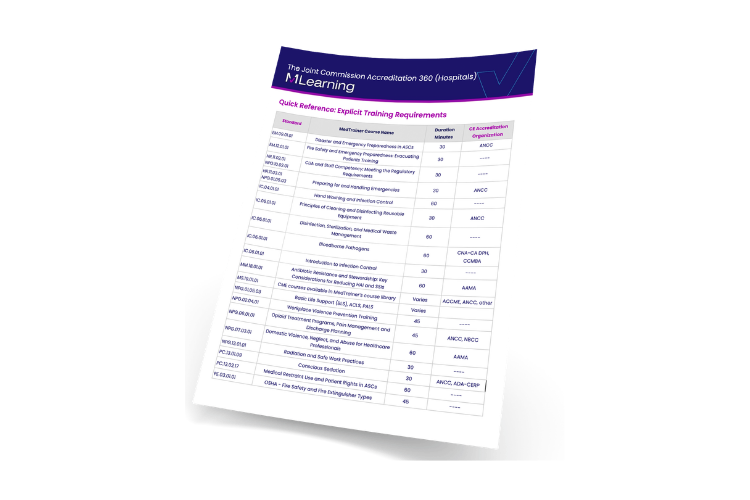
Get a list of The Joint Commission accreditation standards that require training - and a course list.
What is Joint Commission Accreditation & Why is it Important?
As one of the U.S.’s largest and oldest accrediting bodies, The Joint Commission’s accreditation of hospitals is a highly respected symbol of quality widely accepted by payers and regulatory agencies as evidence of an organization’s commitment to high standards of care. If you’re wondering “what is TJC in healthcare,” it may be because The Joint Commission was previously known as JCAHO, or The Joint Commission on Accreditation of Healthcare Organizations.
Healthcare organizations that attain The Joint Commission’s Gold Seal of Approval demonstrate dedication to patient safety and the quality of their services. They can provide a public source of quality validation through the Joint Commission’s Quality Check™.
So why is The Joint Commission accreditation process important to hospitals? TJC’s standards form the basis of the objective evaluation process that helps healthcare organizations assess, measure, and improve their performance. The standards set expectations for reasonable, achievable, and surveyable performance, focusing on essential processes and organizational functions. By seeking accreditation from TJC, healthcare organizations can effectively communicate to the public their commitment to excellence in patient care.
What Does The Joint Commission Accreditation Process For Hospitals Look Like?
The Joint Commission accreditation process changed significantly in 2026 with the shift to Accreditation 360. This change removed more than 700 requirements and introduced a continuous engagement model to keep organizations perpetually survey ready vs. the old “point-in-time” survey readiness. It’s important to note that, for the most part, survey requirements did not change. Standards were combined and many of the requirements are now implied, rather than specifically stated. The National Patient Safety Goals were also replaced with the new National Performance Goals. Here’s a look at the training requirements, including what is now implied or recommended.
Joint Commission Survey Process
The Joint Commission accreditation process involves an objective assessment of performance against standards set by TJC. Joint Commission surveys are unannounced, except for non-deemed initial surveys. During the survey, Joint Commission surveyors evaluate an organization’s performance, tracing patient care, reviewing documentation, and observing and interviewing staff and patients as appropriate. What the surveyor sees on-site is compared against the Elements of Performance (EPs) in the standards. When an EP isn’t met, it becomes a Requirement for Improvement (RFI). A preliminary Summary of Survey Findings Report comes first, and the final accreditation decision happens later.
How Does the Scoring Process Work?
Every finding by the surveyor is plotted on the Survey Analysis for Evaluating Risk (SAFER) Matrix. It provides a single visual representation of findings to help organizations prioritize risk and focus corrective action on issues that need to be addressed first. In the change to Accreditation 360, each EP has a short descriptive name so the matrix is easier to read at a glance.
Possible TJC accreditation process decisions include Limited Temporary Accreditation, Accreditation, Accreditation with Follow-up Survey, Preliminary Denial of Accreditation, and Denial of Accreditation.
Expectations of Accreditation
An organization’s accreditation cycle is continuous, and it should have an unannounced survey within 36 months of its last survey. Organizations must continue to meet all accreditation-related requirements to maintain their accreditation.
Why Should Your Healthcare Facility Seek Accreditation?
The Joint Commission leads the industry with its cutting-edge standards and unparalleled accreditation across the continuum of care, setting the bar for the highest performance and continuous improvement. It is more important than ever for healthcare organizations to achieve excellence in patient safety and quality care. Having a reliable, all-in-one healthcare compliance software like MedTrainer’s can help get to this point.
Improve Patient Safety and Care Delivery
TJC accreditation is a commitment to strive for continuous improvement and achieve excellence in patient safety and care delivery.
- Aligning with Joint Commission standards defines each team member’s role and responsibilities to reduce the risk of patient harm.
- On-site surveys provide professional advice and counsel to enhance staff knowledge and skills.
- The Leading Practice Library offers customized solutions for challenging healthcare problems.
- TJC provides tools to organize and strengthen patient safety efforts, leading to a reduction in compliance issues.
Increase Your Facility’s Bottom Line
Achieving Joint Commission accreditation for your organization demonstrates a commitment to delivering the highest standards of patient care, which can significantly impact your balance sheet.
- Healthcare compliance with Joint Commission standards gains public trust and provides a competitive edge.
- Accreditation establishes a consistent approach to care and reduces the risk of error or low-quality care.
- Attracts (and retains) qualified talent who prefer working within an accredited organization.
Enhance Business Operations
Handling and improving daily business operations in healthcare organizations can be challenging. However, The Joint Commission offers a solution that makes this task manageable for TJC-accredited organizations. TJC provides a range of continuing education support that meets the specific needs of each organization.
The team at TJC comes from various healthcare industries for a personalized and in-depth review. The Joint Commission conducts on-site surveys that help organizations maintain healthcare compliance with the latest standards and provide guidance on improving organizational structure, management, and overall performance.
Earn Recognition in the Field
Achieving Joint Commission accreditation is a testament to healthcare organizations’ exceptional quality of care and dedication to continuous improvement.
- Accreditation earns public recognition and validates outstanding contributions and commitments to quality.
- Accreditation can help organizations qualify for Medicare and Medicaid certification and exemption from regulatory requirements.
- Recognized by insurers and other third parties, accreditation is a prerequisite for reimbursement and participation in managed care plans in some markets.
Simplify TJC Accreditation With MedTrainer
To meet The Joint Commission’s high accreditation standards, you might need some help staying organized and providing real-time reports. MedTrainer, one of the most reliable names in healthcare training, brings compliance training, documentation, incident reporting, credentialing, and more into one easy-to-use platform. MedTrainer is trusted as one of the best compliance software platforms for healthcare organizations nationwide.
MedTrainer’s course library offers all required courses to meet The Joint Commission accreditation standards. Get a list matched up with Accreditation 360 standards for hospitals. Comprehensive policy management keeps every step of the process within MedTrainer and automatic tracking documents redlines, the approval process, policy versions, and staff acknowledgment for a complete audit trail. Customizable reporting offers real-time views of workforce compliance and quickly surfaces gaps, making it easier to maintain continuous compliance.
Find out why accreditation surveyors love to visit healthcare organizations that use MedTrainer.