 Learning
 Credentialing
 Compliance


The average healthcare organization counts on ~$2.3M in annual revenue from each provider – or about $9,000 a day. Any delay in the provider enrollment process means less revenue for the organization – and the longer the holdup, the harder the hit.
Enrollment delays cost nearly a third of organizations polled in a 2023 MedTrainer survey. That makes expediting the provider enrollment process a critical strategy for any healthcare organization.
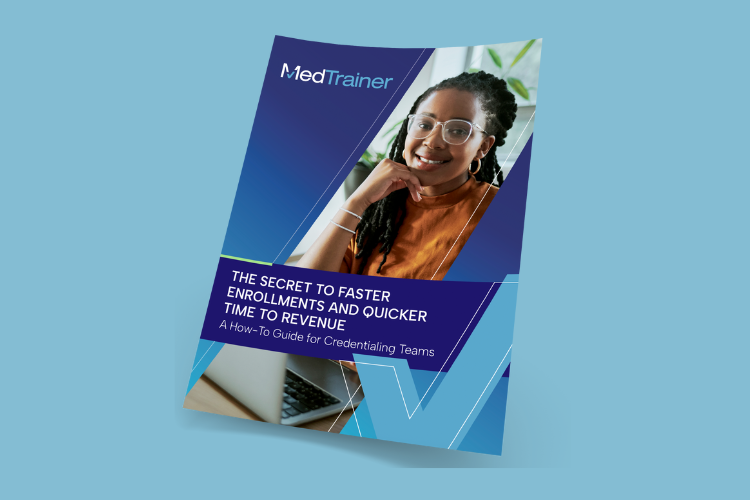
Get the tools you need to eliminate delays in your provider enrollment process.
You can’t control what happens on the payer side of the enrollment process, but you’re in complete control prior to application submission. So, what is the provider enrollment process, and how can you best prepare for it? Let’s focus on conquering all of the tasks that you can control so that you can eliminate delays and revenue loss. We’ll take a look at the most problematic areas of the provider enrollment process and how to leverage technology. Plus, don’t miss the handy enrollment checklist below!
Common Delays in the Provider Enrollment Process
Even the most experienced healthcare credentialing teams encounter slowdowns — and often, it’s not due to a lack of effort. From document delivery delays to payer-side surprises, here are four reasons provider enrollment delays continue to frustrate healthcare organizations.
1. Overloaded Teams, Limited Time
Many credentialing professionals are managing more providers and applications than their bandwidth allows. As provider rosters grow, teams can’t always keep up, especially without dedicated enrollment support. This results in a backlog of pending applications, delayed start dates, and lost revenue opportunities. If your team is stretched too thin, it’s time to reevaluate whether your staffing and strategy can meet today’s demands.
Use this worksheet to see if your current credentialing team can handle the workload.
2. Lack of Visibility
Without a centralized healthcare credentialing system for tracking enrollment status, it’s easy to lose visibility into where things stand. Which payer is holding up the process? What’s missing from the application? When executives lack clarity, credentialing delays become a hidden risk to operational and financial performance. Standardized workflows and real-time reporting are essential to avoid surprises.
3. Constantly Changing Payer Requirements
Payers frequently update their requirements — from new documentation to portal changes or shifting timelines. These mid-provider enrollment process updates can force teams to start over or resubmit information, turning a simple task into a weeks-long setback. While these disruptions are out of your control, your systems and workflows should be built to adapt quickly.
4. Enrollment That Isn’t Prioritized
When enrollment isn’t treated as a top priority, everyone slows down. Providers may delay document submission. Credentialing teams may juggle multiple urgent tasks. Payers may take advantage of the lag. Without clear accountability and urgency, enrollment timelines slip — and with them, your organization’s ability to generate timely revenue.
What Is the Provider Enrollment Process?
A provider enrollment process checklist organizes tasks to complete enrollment applications completely and accurately, the first time. Here’s a template that you can adapt for your own organization and payers.
Enrollment Application Checklist
- Gather Training and Education
- Practitioner degree (MD, DO, DPM), post-graduate education or training
- Medical or professional education/training details
- Designated specialty residency completion
- Gather Licensing and Certification
- Current license/certification in the state(s) where provider will be practicing
- No temporary licenses
- National Provider Identification (NPI) number
- Specialty
- Surgeons needs board certification, RNs don’t need anything else
- Active DEA number and/or Controlled Dangerous Substance (CDS)
- Certificate or acceptable substitute (if required)
- Medicare/Medicaid participation eligibility or certification (if applicable)
- Current license/certification in the state(s) where provider will be practicing
- Gather Work History Details
- Five-year work history. Explain any gaps longer than six months
- Statement of work limitations, license history, and sanctions
- Only required if you are applying to join UnitedHealthcare’s Medicare and Medicaid plans
- W-9 form
- Hospital staff privileges
- Gather Payer-Specific Requirements
- Active errors/omissions (malpractice) insurance or state-approved alternative
- Malpractice history
- Special needs survey
- Letter of intent
- Disclosure of ownership statement
- AMA profile or criminal history review as required by credentialing authorities
- Notification if provider has ever been a delegated provider before this application
- Complete credentialing application in portal
- Following Application Submission
- Check application at week one
- Check application at week two
- Obtain credentialing approval via portal
Download a copy of this provider enrollment checklist, plus a bonus post-decision checklist by downloading Tools To Conquer Provider Enrollment.
Get the tools you need to eliminate delays in your provider enrollment process.
How Healthcare Credentialing Software Drives a Speedy Provider Enrollment Process
Provider enrollment software offers several benefits that help credentialers speed up the process. Here’s what to look for.
Simplifies Provider Data Management
Streamline your enrollment processes with the most up-to-date provider information at your fingertips with a direct CAQH integration. Through this innovative enterprise-level relationship, MedTrainer customers will now enjoy seamless software integration of provider records from the CAQH Provider Data Portal via an official, permission-based API.
With MedTrainer credentialing’s secure API, there’s no more chasing down paperwork, dealing with delays, or getting stuck in administrative backlogs. Provider data management is easier than ever with comprehensive provider profiles automatically filled with data pulled directly from CAQH.
Built-in Automation
Keep the enrollment process moving forward with automated reminders for providers to send documents, notification of recredentialing deadlines, and license expiration.
Automatically generate credentialing packets based on your own customized list of required documents. The best part is that when you (or the provider) upload new documents that should be in the packet, the packet updates in real time!
Transform hours of tasks into seconds with automated license verifications. Creating DEA and state license verifications for all license types, software like MedTrainer pulls data and images from the original source through a unique partnership.
Highly Customizable Reports and Dashboards
Healthcare credentialers can spend less time tracking and more time working directly with payers and providers when reporting is customizable and automated. Save your favorite reports for easy access, and schedule them to be emailed to internal and external recipients so you — and leadership — are always up-to-date on progress and can quickly identify issues.
Actionable Provider Enrollment Workflows
Simplify enrollment processing with a customized workflow, including a process checklist with embedded notes and task assignments. Easily assign multiple enrollments to staff, update statuses, and prioritize.
Group Enrollment Workflows
Get fast and accurate results with group enrollment workflows. This is a dedicated page for group enrollments that allows credentialing professionals to manage provider enrollments tied to a single tax ID or organizational NPI without the need for workarounds. This capability reduces administrative tasks, ensures enrollment accuracy for large groups of providers, and prevents delays in providers seeing patients.
Auto-Fill Enrollment Applications
With auto-filled enrollment applications, you can eliminate bottlenecks that slow down credentialing and make sure the right data ends up in the right place, every time. Automated form-filling pulls data directly from the digital provider profile to populate any form, including credentialing applications, privileging requests, and enrollment documents. This reduces redundancy, minimizes errors, and frees up valuable time for your team to focus on higher-impact tasks.
Take the Next Step To Improve Your Provider Enrollment Process
Credentialing is evolving. With the advancement of credentialing technology, the next step to making your organization’s provider enrollment process a strength rather than a setback is leveraging healthcare credentialing software to automate routine tasks, set smart reminders, and save your organization time and money.
With the help of robust credentialing software, you can enroll providers faster with tools like automated credentialing packet generation and automated license verifications, and begin generating revenue sooner. With these tools, you’ll be better able to avoid any delays that prevent your providers from seeing patients and costly fines for your facility.
Download The Secret to Faster Enrollments and Quicker Time to Revenue, an in-depth guide with valuable tips on speeding up the time from credentialing to enrollment approval. You’ll find the Enrollment Application Checklist and a Post-Payer Decision Checklist with steps to follow for approvals, denials, and rejections.
Want more? Schedule your demo to see MedTrainer Credentialing Software in action.