 Learning
 Credentialing
 Compliance


Hiring new staff should be exciting. But for many healthcare organizations, the path to productivity takes longer than it should. When training, credentialing, and onboarding tasks drag on, new hires can’t contribute as quickly, and organizations lose valuable time. Slow starts not only delay readiness but also strain teams that need support right away.
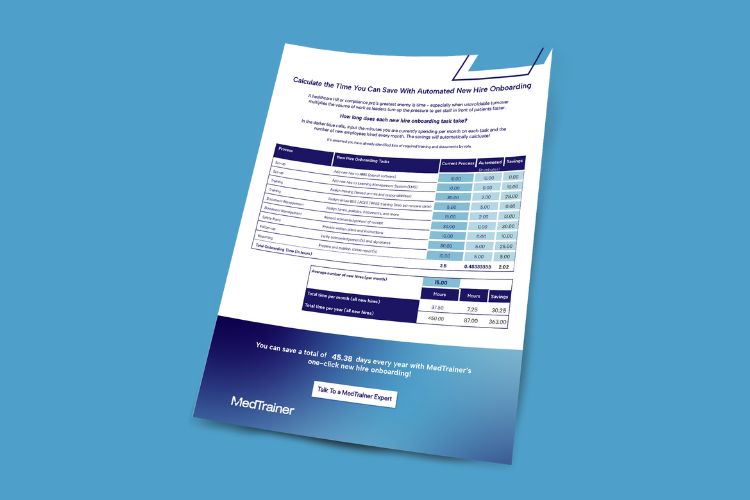
Calculate the time you can save with automated new hire onboarding.
The good news? Automated healthcare compliance onboarding removes those barriers by giving teams a faster, more reliable path to compliance. It brings structure to every step, from assigning training to tracking completion, so new hires start day one confident, prepared, and ready to contribute.
In this article, I’ll explore why onboarding so often breaks down, how automation closes those gaps, and the benefits organizations gain when an all-in-one healthcare compliance software supports them from day one.
Why New Hires Take Too Long To Get Trained and Productive
What’s holding you back?
Why does onboarding take longer than planned? Across healthcare, manual processes and lack of automation are the leading barriers to new employees achieving full compliance. When onboarding runs on inconsistent steps and manual follow-ups, even simple work drags. Delays grow as teams try to manage training, credentialing, and documentation without a structured process. And what should move new hires forward ends up slowing them down, turning an important process into a constant source of catch-up.
Onboarding Workloads and Manual Processes Create Hidden Slowdowns
Onboarding hold ups often hide in small tasks. You assign courses, check completions, collect signatures, and confirm credentials. Each task feels quick, but the workload rises fast. Over a month, time spent onboarding can reach up to 38 hours for teams hiring 15 people, and it compounds if your organization scales or experiences a hiring surge.
Every reminder, follow-up, and progress check pulls time away from higher-value work and raises compliance risk. When too much of onboarding depends on manual tracking, the process becomes harder to manage and more prone to mistakes. Staff spend their days chasing tasks instead of helping new hires succeed, and the entire cycle slows down.
Inconsistency Is the Indicator of a Problem
Inconsistency is the underlying issue. When departments follow different steps, timelines, or tracking, results vary. Some employees move through quickly, and others wait for access, approvals, or missing items.
Automated healthcare compliance onboarding creates one reliable process across locations and roles. Consistency removes guesswork, reduces risk, and helps new hires start confident and prepared. When every part of onboarding follows the same structure, teams spend less time catching up and more time moving forward.
What Automation Solves That Manual Processes Can’t
Manual onboarding is more than just slow — it’s risky. When compliance tasks are handled by hand, things slip through the cracks:
- Missed deadlines can trigger survey findings and penalties.
- Scattered documentation makes audits stressful and time-consuming.
- Delayed credentialing slows down how quickly staff can start working.
- Administrative overload drains time away from patient care.
These gaps create stress for administrators and uncertainty for new hires. It’s a cycle that undermines compliance and can contribute to turnover.
Solving these challenges takes a structured approach that reduces time to productivity and removes the risk of missed steps. Automated healthcare compliance onboarding makes this possible:
- The right training and documentation are assigned automatically.
- Completion is tracked and available in customizable reports.
- Notifications and reminders prevent deadlines from being missed.
- Leaders always know their healthcare compliance status at a glance.
- Credentialing processes are accelerated with automated CAQH data imports and provider document collection.
Instead of worrying that training and onboarding are taking too long, teams follow a process that runs the same way every time. Automated healthcare compliance onboarding makes sure tasks get done. You don’t need to double-check every move or guess who missed a step because the system already handled it.
The Real Benefits of Automated Healthcare Compliance Onboarding
The impact of healthcare onboarding automation for new hires goes far beyond saving a few clicks. It transforms how both administrators and new hires experience onboarding.
Reduce onboarding errors with HRIS integrations
When onboarding platforms connect directly to HR or payroll systems, employee data flows automatically. HRIS integrations reduce manual entry, prevent mistakes, and keep records consistent across the organization.
Ensure compliance with automated course assignments
Automated workflows assign the right training and policies based on role, department, or location, so that every new hire starts with exactly what they need. No oversights, no gaps. Assignments can also be set up before the employee’s official start date, allowing new staff to complete required training in advance so they arrive on day one fully compliant and ready to begin work.
Day-One Compliance for Every New Hire
An automated healthcare compliance onboarding system sets up new employees to complete required training and documentation online, from anywhere, before their first day if needed. Automated reminders keep tasks visible and on track. And once employees begin work, administrators can confirm progress and address remaining gaps so new hires reach full compliance as soon as possible.
Standardize onboarding for every new hire
Instead of each department or location handling compliance differently, automation standardizes the process. Every new hire gets the same role-appropriate training and policies, eliminating guesswork. That consistency prevents delays and makes it easier for managers to support staff from the start.
Stay audit-ready with automated compliance tracking
Automation creates a complete, time-stamped record of training, policy acknowledgment, and certifications. Leaders can walk into audits knowing they have what they need, without pulling staff off other work to track down information. This improves overall training. Credentialing workflows can automatically collect provider documents and import CAQH data, so that all licenses, certifications, and records are accurate, current, and audit-ready.
Improve new hire experience with day-one compliance
When onboarding is a smooth process, employees will start their roles without confusion. They know what’s expected, have access to the right systems, and feel supported from day one. This reduces early turnover and builds trust.
Automated healthcare compliance onboarding creates a proactive compliance culture where staff, leaders, and regulators know that training and the path to productivity aren’t taking too long. That shift — from constant catch-up to consistent readiness — is where real confidence comes from.
How MedTrainer Makes Day-One Compliance Easy
Manual onboarding often leaves teams questioning how long it’s taking to get new employees trained and productive. The process can feel slow and uncertain — missed deadlines, scattered records, and added stress for administrators. Automated healthcare compliance onboarding solves those problems by making compliance proactive, fast and reliable.
That’s exactly what MedTrainer delivers. With automation built directly into the healthcare onboarding software:
- Training and documentation are assigned instantly by role, department, and location.
- Healthcare-specific content covers OSHA, HIPAA, and other evolving regulations.
- Efficient integrations with HR systems like ADP, UKG, and Paylocity keep employee data synced.
- Certificates issue instantly, with centralized tracking that’s always audit-ready.
With MedTrainer, new hires start compliant on day one, administrators gain back valuable time, and leaders can finally stop worrying about how long it takes.
Schedule a demo to see how MedTrainer simplifies onboarding and compliance.