 Learning
 Credentialing
 Compliance

Keeping healthcare workers safe is a top priority at any facility, and often, that starts by observing standards set by the Occupational Health and Safety Administration (OSHA), including OSHA training for healthcare workers. OSHA standards require employers to conduct employee training for job safety relevant to the day-to-day tasks and potential risks workers face. It is the employer’s responsibility to provide healthcare workers with information about their rights and responsibilities, the responsibilities of leadership, how to file a complaint, and how to identify and prevent safety and health hazards.
OSHA training for healthcare workers must be completed quickly after the employee is hired, and annually thereafter for many topics (depending on the employee’s role). Contract workers are also required to provide proof of training, so even if an organization is relying on temporary or traveling providers, there’s still a burden to provide documentation of OSSH training completion.
Many healthcare organizations use a learning management system (LMS) to assign the training prior to the employee’s first day of work, so the new hire can immediately jump into the role. It’s critical to track completion of the OSHA training and document the date in case of an adverse event, OSHA inspection, or accreditation survey.
Take this 10-question quiz to check your preparedness for your next audit.
In this article, I’ll share the required topics for OSHA training for healthcare workers as well as strategies to improve your healthcare organization’s training process, tracking, and timing.
Required OSHA Training for Healthcare Workers
Hospitals have a lot on their plates. Between staffing gaps, budget cuts & nonstop compliance work, it’s easy for training to slide under the radar. But getting safety training right can take some of the pressure off. It helps people feel more confident, more capable, and a lot more prepared to deal with the stuff that comes up on the job.
Here’s what healthcare workers need to be trained on to meet OSHA rules:
- Exit Routes and Emergency Planning. Staff need to know how to get out safely and where to go. Emergency action plans help teams stay calm, move quickly & get to safety when things go sideways.
- Hazard Communication. Dangerous chemicals show up in all kinds of places. Training covers how to handle, store & get rid of them without causing harm. It also goes over SDS files and what GHS labeling means in real life.
- Personal Protective Equipment (PPE). Not all gear fits every situation. This training explains what to wear, when to wear it, and how to keep it working like it should.
- General Environmental Controls. Covers the basics of keeping a healthcare space clean and safe – from sanitation to waste bins to making sure spills don’t turn into slip risks.
- Medical Services and First Aid. Goes over what to do if someone needs help, how to respond quickly, and what needs to be stocked so nobody has to scramble in an emergency.
- Emergency Action Plans and Fire Protection. Fire safety isn’t optional. This training covers fire prevention, where extinguishers are kept, how to use them, and how to get everyone out of the building fast.
And here are the extra topics that kick in if a worker’s role brings them into contact with these risks:
- Toxic and Hazardous Substances. Focuses on spotting, understanding, and working around dangerous substances without creating health risks for patients or staff.
- Bloodborne Pathogens. Covers what workers need to know to avoid exposure to things like HIV, Hep B & Hep C. Includes safe practices and steps to take if something goes wrong.
- Ionizing Radiation. For folks around X-ray machines or similar equipment, this training explains how to stay safe, how to track exposure, and how to meet the legal rules around radiation.
OSHA Training for Healthcare Has Never Been Easier
Since OSHA training is required for anyone with workplace hazard exposure, there are a lot of courses to keep up with and track. Healthcare learning management systems help organizations stay up-to-date with the latest regulations. You don’t need to be searching, bookmarking, or worrying about fines and penalties. On-demand, online access to OSHA courses allows employees to learn at their own pace for a convenient and efficient learning experience.
Furthermore, software with built-in tracking and reporting tools makes it easy for organizations to monitor employee progress, maintain accurate records, and generate essential reports for compliance. Overall, a comprehensive platform improves the training process. It enhances the learning experience and simplifies compliance management for healthcare organizations.
Automate Initial OSHA Training
OSHA requires training to be completed within 30 days of hire. Instead of waiting until the new hire’s first official day, assign online training courses as soon as a contract is signed. Automated new hire onboarding can kick-start this process without any administrative work. When you add a new employee, training (and new hire paperwork and policy acknowledgments) can be automatically assigned based on the employee’s role, location, and department. This removes the manual tasks of compiling and sending the training requirements so the new hire can get started more quickly. See how it works.
Combine Requirements and Refresher Training
OSHA training must be completed annually. However, this can be considered “refresher” training, and savvy healthcare organizations combine multiple topics into one course to reduce redundant training time for employees. MedTrainer offers a course that can be used for this “refresher” training and includes the required information on general safety, airborne and droplet diseases, hazardous communication, identification of regulated medical waste, bloodborne pathogens, PPE, needlestick safety, and incident reporting. For initial training, select courses that meet multiple regulatory requirements – for example, a disaster preparedness course that meets both OSHA and CMS guidelines so employees don’t have to take two separate courses.
Stagger Annual Training
Assigning annual healthcare compliance training to all employees at once can ground your healthcare organization to a halt. Most HR or compliance leaders would like to manage a staggered training schedule, but keeping track of assignments, completions, and more can turn into a full-time job! Technology makes it much simpler with automated course reassignment. Schedule initial training as part of onboarding (you can assign this in bulk) and then set the courses to be automatically reassigned annually. The training is naturally staggered by hire date, and the employees will receive reminder emails until the training is complete.
Leave the Research To Someone Else
It can be incredibly time-consuming for an employee or team to stay up-to-date on changing regulations. In addition to federal OSHA regulations, most states also have worker safety rules to follow, such as Cal-OSHA in California. Instead of using an in-house team to complete this research, choose an LMS vendor that focuses on healthcare and stays up-to-date on policy changes. The best healthcare learning software creates courses agilely so they can change classes in one to two weeks if needed, and gaps in training coverage can be filled quickly.
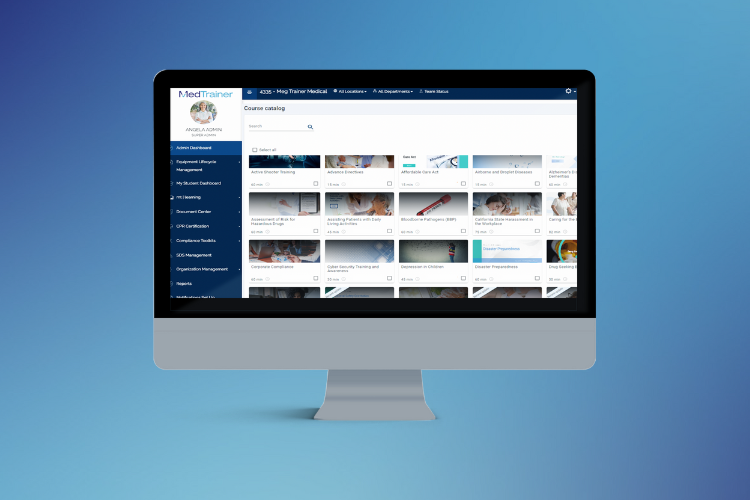
All the Courses You Need, All in One Place — That's MedTrainer Learning.
Software That Simplifies OSHA Training
MedTrainer’s healthcare learning management system provides healthcare organizations with a comprehensive solution for maintaining a safe and compliant work environment. There’s no shortage of training options here. You’ll get courses that cover every OSHA training requirement for healthcare staff, plus continuing education and other programs tied to federal rules or accreditation. With close to 1,000 healthcare-specific courses in the library, your team gets material that stays current with what regulators expect.
With MedTrainer’s help, managing compliance becomes a painless process, allowing your organization to focus on delivering exceptional patient care. Take advantage of the opportunity to elevate your organization’s safety and compliance standards.
Schedule a demo today and discover how MedTrainer can transform your healthcare compliance management experience.