 Learning
 Credentialing
 Compliance


Manual compliance tracking often feels like the simplest and cheapest option, but a look at the real cost tells a different story. Organizations may believe they are saving money by using familiar, manual processes, yet these methods quietly compound expenses over time. Think about how much time staff spend chasing people to complete training. Wasted labor hours, excessive paperwork, and inefficient audits create substantial direct costs. Administrative inefficiencies contribute to an estimated $760 to $935 billion in waste annually — roughly 25% of all U.S. healthcare spending.
At the same time, the risks of non-compliance penalties and operational breakdowns add even greater indirect costs. The longer organizations rely on outdated methods, the greater the operational risk and financial strain. This blog breaks down the real costs of manual compliance and how automation offers a smarter, more sustainable path forward.
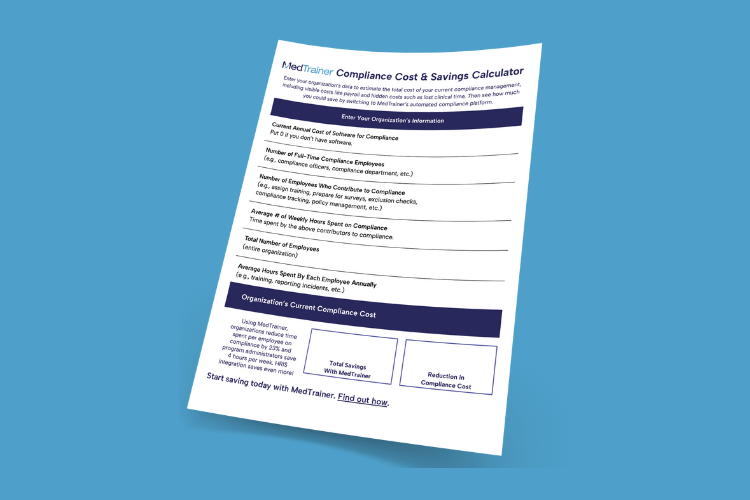
Use this easy worksheet to see how much compliance is really costing your organization.
Manual Compliance Isn’t Free — It’s Expensive
At first glance, managing compliance through spreadsheets, binders, and email workflows may appear cost-effective. But these manual processes often create hidden costs that don’t surface until they impact clinical care, financial performance, or accreditation readiness.
Time Spent By All Staff
The most immediate and measurable impact of manual compliance is the direct cost to your organization. This includes wasted labor hours, excessive paperwork, and the time-intensive work of tracking training records and policy acknowledgments. Even if you don’t have dedicated full-time compliance staff, you’re paying people across departments to do the work.
One of the most overlooked costs of manual compliance is the time it takes from senior leaders. When VPs or department heads have to double-check spreadsheets or resolve compliance issues, their attention is pulled away from higher-value work. These tasks may seem small, but they add up — wasting valuable time and slowing progress across the organization.
Preparing for surveys or audits becomes particularly costly in manual environments. Even more employees are pulled in to gather files, documents, and spreadsheets from multiple sources to build a paper trail that could otherwise be accessed instantly. The result is excessive paperwork and avoidable administrative effort that directly adds to an organization’s compliance costs.
Time Spent Chasing People
Inefficiencies associated with manual compliance tracking have a huge impact on staff who are spending hours checking individual training completions, searching for compliance training materials, and interpreting regulatory requirements without centralized tools. Tasks that should take minutes — like uploading compliance records or initiating incident report reviews — can stretch into hours of unnecessary work. Each manual step represents preventable labor costs and lost productivity across the organization.
If training completion requires regular follow-up, it is worth paying attention to how much time that effort actually takes. It is not just reminders. It is checking completion status, re-running reports, answering questions, and circling back when something slips. When it happens week after week, it often becomes one of the quiet ways your time disappears. It rarely shows up as a clear line item, but it becomes part of the real cost of keeping training compliant. When you step back and look at how time and manual effort contribute to overall compliance operations, including how they add up financially. This compliance cost analysis can help put that impact into perspective.
When training depends on repeated chasing, consistency becomes harder to maintain. Coverage feels fragile. Confidence drops as requirements expand and expectations change. At that point, the issue is no longer effort or accountability. It is whether manual policy tracking and training tracking can keep up without ongoing manual follow-through.
The Cost of Errors
Data entry mistakes are common in paper-based or spreadsheet tracking, leading to inaccurate records that must later be corrected. A mistyped number or missing field can result in multiple forms and verifications to be redone, compounding staff time and frustration. Paper records are also vulnerable to being lost, damaged, or misplaced, forcing teams to duplicate documentation efforts. Missed signatures, overlooked fields, or failing to notice when a license has lapsed can create critical delays, including preventing providers from practicing. Manual processes also expose sensitive documents to greater risk of unauthorized access or loss, potentially resulting in costly regulatory violations.
The consequences of these errors can be severe. A single non-compliance event can result in revenue losses of up to $6 million, due to enforcement actions, investigations, and operational downtime. For organizations facing a data breach, the financial toll is even higher — averaging $9.77 million per incident. In 46% of cases, the compromised information involves personal health data, causing HIPAA violations and long-term reputational damage. For smaller organizations, even a fraction of these costs could be devastating.
More than just financial consequences, poor compliance tracking also weakens operational integrity. It can delay provider onboarding and create confusion across departments when policies aren’t current. The manual steps involved often require multiple rounds of email follow-up, back-and-forths across HR, compliance, and credentialing teams, and lost hours for clinical leadership. These opportunity costs are rarely calculated but deeply felt.
How Leading Organizations Save Money With Compliance Software
Automation dramatically reduces the compliance burden by replacing time-consuming tasks with efficient, repeatable workflows. That’s why 88% of healthcare leaders say automation is essential for addressing administrative burden and staffing shortages. If your current process depends on chasing staff, you are left reacting to risk instead of seeing it early. So, while there is a cost for healthcare compliance software, savvy healthcare leaders have realized that it is dramatically less than the hidden costs they’re wasting on manual compliance tracking.
Here’s a look at how a compliance management system saves money.
New Hire Onboarding
Healthcare compliance onboarding software automatically assigns training, HR forms, and policies by role, department, and location as soon as a new hire is added to the system. Reminders are sent until all tasks are complete, so you no longer have to chase down employees. On average, this saves about 2.5 hours per employee — use this calculator to determine how much time you can save. This efficiency is multiplied by every new hire, so in a large or growing organization, the savings can be substantial.
Preventing Penalties
Automated training completion reminders and license expiration notifications keep your organization compliant — in less time. Instead of a valuable employee spending five minutes or more per manual follow-up email, reminders can be automatically sent on a pre-set schedule. Annual training assignments can be scheduled in advance and deployed across the organization, helping ensure nothing is missed.
Automated exclusion checks typically take about five minutes per employee each month when done manually, but software can check all exclusion databases every 30 days, sending an email notification when there’s a change in status. This not only prevents penalties, but also denied reimbursements.
Automated Tracking and Reporting
As I mentioned earlier, spreadsheets and manual tracking are responsible for costly errors and wasted time. Automated compliance tracking and reporting handles the tedious details, including policy acknowledgment, incident report resolution, and training completion. You get real-time visibility into potential compliance gaps to take your organization from reactive to proactive. Even small efficiencies add up quickly and help create a more consistent, error-resistant compliance environment.
Standardized Processes
The operational impact is clear. Automation improves visibility, lowers administrative overhead, and establishes scalable systems that grow with your organization. Process standardization eliminates down time and questions, instead keeping all employees on track with pre-set, approved workflows. Examples of processes you should immediately standardize include: incident report reviews and resolution, training assignment across all locations, and required updates to policies and procedures.
Take the Next Step Toward Smarter Compliance
The hidden costs of manual compliance tracking reach every part of a healthcare organization, from delayed onboarding and fragmented data to missed training and massive financial penalties. For organizations already stretched thin, manual systems are no longer sustainable.
Compliance automation is not a luxury. It’s a necessary step toward financial resilience, operational efficiency, and reduced risk. It replaces chaotic processes with structured workflows, ensures staff have access to current policies, and provides leadership with real-time insights into readiness and risk. From outpatient clinics to multi-site health systems, automation helps healthcare leaders control what’s controllable in a high-stakes environment.
Is your organization ready to stop paying the hidden costs of manual compliance tracking? Schedule a demo with MedTrainer to see how automation can turn compliance into a strategic advantage.