 Learning
 Credentialing
 Compliance


Key Takeaways
- Inconsistent compliance practices often develop quietly across departments, locations, and teams.
- Fragmented processes and recordkeeping make it harder to prove compliance during audits and inspections.
- Centralized compliance management systems reduce variation, strengthen documentation, and lower organizational risk.
When was the last time you looked closely at how consistently compliance is implemented across your sites and teams? Not just what policies say on paper, but how processes, training, documentation, and handoffs actually run day to day and how often they vary.
If the same form is completed three different ways, if a patient privacy request takes five days in one location and fifteen in another, or if no one can say with certainty which policy is current, you are looking at small workflow breaks that add up. As these inconsistencies spread across departments or locations, they drain time, introduce variability into documentation and controls, and increase compliance exposure.
You don’t have to wait and wonder when these inconsistencies will put your organization at risk. They probably already are.
In this article, I’ll help you identify inconsistent practices that may be happening today, understand the impact and potential risk they create, and share how a compliance management system removes inconsistency while reducing the workload it takes to stay compliant.
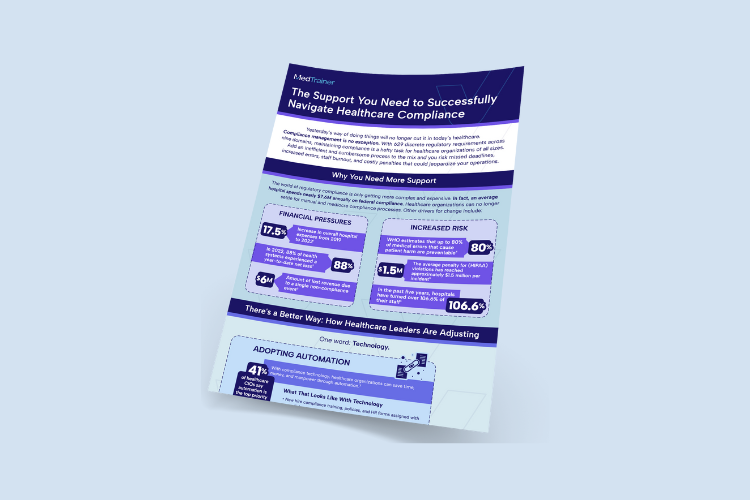
Find out why you need to start thinking differently about healthcare compliance.
What Inconsistent Compliance Practices Look Like in Healthcare Organizations
Inconsistent compliance processes can be hard to identify and even harder to keep in check. Environmental rounds and spot checks help confirm that processes are being followed, but those checks require time and resources that are already stretched. Here are some questions to ask yourself to understand the impact of inconsistent compliance practices on your organization’s risk level.
Uneven Implementation and Follow-Through
From onboarding new hires to renewing annual training requirements, each cycle introduces opportunities for variation. Here are questions to ask yourself:
Do all staff in the same role receive identical training, regardless of department and location?
It’s not enough to know that all locations are providing the required training. You need confidence that everyone is receiving the same information and following the same processes. As soon as adaptations are made, then one group is getting superior training and it will show in patient interactions and incident volume.
Do employees follow a set process for incident report resolution?
Incident resolution breaks down when ownership and documentation are unclear and there is no single defined process, so cases move at different speeds, details get missed, and repeat issues go untracked. A consistent process resolves incidents the right way every time, aligns with your standards, and prevents small problems from becoming larger recurring issues.
Fragmented Recordkeeping and Compliance Data
Documentation and data may not feel urgent every day, but before a survey, audit, or leadership review, it takes center stage and the hunt for information becomes stressful. When compliance data lives in different systems, a full picture of readiness is hard to see.
Is your compliance data in multiple places?
Data collection should not become another task. Its value is visibility and action. Reliable data should help you spot trends and areas that need attention. The information you rely on should be ready and usable the moment you need it.
Can you prove staff are compliant?
Without a standard process, every department or location tracks progress differently. Even if a column is added or removed from a spreadsheet, it can impact your organization’s defensibility. While one training doesn’t seem like a big deal, it opens your organization to liability if an incident could have been prevented or handled more efficiently.
Inconsistent Execution Across Teams and Locations
Variation also appears in how processes are carried out across teams or sites. Even with the same framework, departments can apply requirements differently.
Do you have lists of required provider documents by payer?
A document checklist is completed in one location and skipped in another. One team documents follow-ups right away while another waits. These differences grow quietly, especially when work depends on paper records or manual sign-offs.
Do you use automation to assign tasks, like training and policy acknowledgment?
When processes depend on people remembering every step rather than trusting consistent systems, tasks get missed and gaps form. What starts as a small variation in one site’s workflow can expand across departments until no two locations handle a process the same way. Those differences may stay hidden for a long time, but they make sustained compliance much harder.
Inconsistent Policy Updates and Documentation
Creating and maintaining policies takes real time. Researching requirements, gathering feedback, and making updates can take days or weeks. The challenge is not only writing the policy but getting approval, distributing to staff, and training on procedures.
Are you tracking policy versions and when the next update is needed?
When there is no reliable, repeatable update process, staff are working from whatever policy they can find. Someone pulls a copy from a shared drive, another searches old emails, and a third relies on a version saved months ago. After hours spent aligning policies to standards and considering your facility’s risks, finding that staff still use last year’s version is frustrating and wasteful.
Recognizing the Patterns Before They Grow
A strong team and a strong program do not make you immune to inconsistency, which is why staying ahead is better than cleaning up after the fact. The small gaps you notice today are the simplest and least costly to fix when they are still small. Left unattended, those same gaps move beyond risk into tangible compliance failures.

Building Compliance From Foundation to Automation
When Risk Becomes Real
When compliance inconsistency takes root, its impact is felt across every level of an organization. What once seemed like small oversights begin to demand attention. These moments are where the risk becomes real.
Regulatory and accreditation consequences surface when inconsistencies start to show during audits, surveys, or reviews. Requirements that were once straightforward become harder to prove, and documentation that should align begins to conflict. Even well-prepared teams can face citations or mandatory corrective actions that carry financial penalties and endanger their accreditation status. Each round of additional scrutiny takes time, takes time, pulls people from improvement work, and slows other priorities.
Financial pressure builds even when no findings are on the table. The hidden costs of inconsistency grow quietly every day — see how much compliance is really costing your organization — as hours spent redoing documentation, preparing reports, and tracking updates continue to pile up. These costs often exceed the visible fines or repayment demands that come later and create a continuous drain on time, budgets, and staffing.
The reality is that these outcomes are preventable. With the right technology in place, compliance stops being a source of risk and becomes a strengthening mechanism for the entire program. Systems designed to promote consistency and visibility make it easier to identify gaps early, protect against avoidable costs, and maintain confidence across every level of oversight.
How Compliance Management Software Builds Consistency
Healthcare workforce compliance software transforms your processes from something you manage reactively into a system you can rely on every day. By connecting policies, training, documentation, and reporting in one secure platform, it gives you a single source of truth that keeps teams aligned and reduces the opportunity for teams to “go rogue.” Consistency across locations becomes attainable, confidence in readiness grows, and compliance evolves from a recurring challenge into a lasting strength.
MedTrainer’s simple controls and clear workflows help consistency become your norm. Policy changes are documented and distributed the same way every time and with easy access, everyone uses the same version. Automated onboarding workflows make sure every new hire in the same role completes the same training — regardless of department or location. Dashboards show progress across sites so teams spot gaps early and fix them the same way everywhere.
Schedule a demo to see how MedTrainer will help your organization simplify compliance, strengthen consistency, and move forward with confidence.