 Learning
 Credentialing
 Compliance

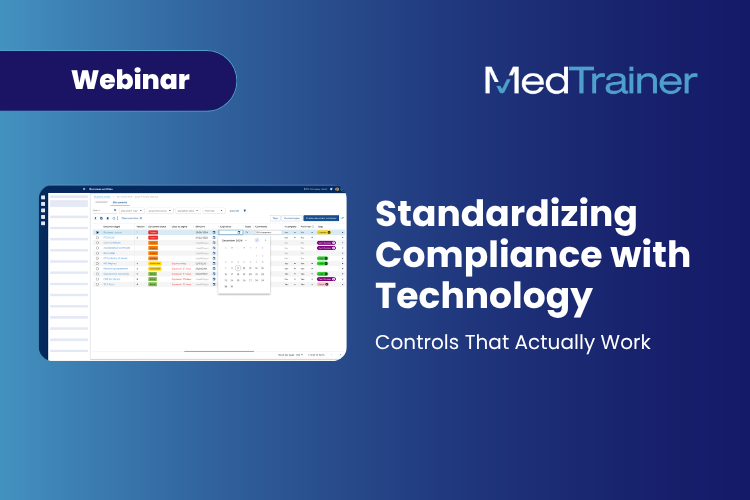
If your compliance process depends on institutional memory, it’s not a process — it’s a risk. Healthcare organizations are dealing with more regulatory pressure, faster staff turnover, and more complex growth than ever before. Without standardized systems in place, the gaps that are manageable at one site become serious liabilities at five.
In this on-demand webinar, Chris Seymour, Senior Solutions Consultant at MedTrainer, shares what it actually takes to get compliance under control. Chris brings nearly a decade of experience in the healthcare tech industry and a background that spans software implementation, survey preparation, and credentialing.
Common questions we’ll address in this webinar:
- What are the signs your organization lacks compliance consistency?
- Which processes should every healthcare organization standardize?
- What controls should you look for in software to make standardization stick?

Standardizing Compliance With Technology: Controls That Actually Work
Why Does Healthcare Compliance Consistency Matter More Than Ever?
In the beginning of the webinar, Chris shared why healthcare organizations can’t afford to operate without standardized compliance processes, and what the consequences of inconsistency look like in practice.
Why Does Staff Turnover Create Compliance Risk?
Healthcare has become increasingly transient. Staff come and go, organizations get acquired, and growth keeps accelerating. When people leave, they take institutional knowledge with them. Without standardized processes in place, that knowledge gap becomes a compliance risk.
What Happens to Compliance Gaps as Your Organization Grows?
A compliance gap that’s manageable at one site becomes a regulatory liability at five. Growth through acquisition means multiple sites operating under different standards. Standardization has to scale with your organization, or the risk scales with it.
What Happens When Someone Leaves Without a Standard Process?
When someone leaves and there’s no standard process, no one knows where things are or what needs to be done. Policies go missing. Training records are incomplete. Credentialing tasks fall through the cracks.
Why Can’t a Manual Compliance Approach Keep Up?
Healthcare moves fast. People are coming and going, patients are in and out, and requirements keep changing. A manual, ad hoc process depends on whoever happens to be responsible at the time. When that person is unavailable, things get missed.
How Do Regulatory Requirements Make Compliance More Complicated?
Accreditation requirements, federal funding status, and state regulations all layer on top of each other. For accredited facilities or federally funded organizations, the red tape compounds quickly. A consistent process is the only way to manage it all without something slipping through.
Want to learn more? Here’s how to see the full webinar.
What Areas Every Healthcare Organization Should Standardize?
Next, Chris shared the seven core areas of compliance management that healthcare organizations need to standardize, and why each one matters.
- Where and how tasks are completed — standardizing ownership and process means nothing gets lost when staff turn over
- Policy management — without a standard process, policies go outdated and get misplaced, leaving your organization exposed during surveys
- Onboarding — role-specific, automated onboarding ensures every new hire meets compliance requirements consistently, not just when the right person happens to be available
- Provider data management — a standardized system prevents licenses from lapsing, keeps providers practicing, and protects your organization’s revenue
Find Out if Your Healthcare Compliance Program Has the Right Controls
Understanding each area of healthcare compliance is one thing. Building a standardized process for each of them is another. MedTrainer’s all-in-one compliance platform can help.
MedTrainer’s healthcare learning management system makes training consistent across your entire organization. Pre-set course assignments by role, department, and location help every employee get exactly what they need. The MedTrainer Course Library offers 1,200+ healthcare-specific courses, plus customizable dashboards to track completion in real time.
MedTrainer Compliance centralizes and standardizes documents and workflows. Automate policy approvals, set expiration reminders, and maintain a full audit trail with version history and electronic signing. Online incident reporting standardizes submissions with built-in escalation so nothing gets missed.
MedTrainer Credentialing keeps providers on track and audit-ready. Enforce mandatory document requirements by specialty and location, automate primary source verification and exclusions monitoring, and get ahead of expiration dates before they become a problem.
Watch the full on-demand recording to get the complete picture.