 Learning
 Credentialing
 Compliance
Credentialing is one of the most critical, and often most frustrating, responsibilities for medical practices. When paperwork piles up and timelines slip, it’s an administrative headache. Worse, it’s a revenue risk and a compliance concern. Many teams are still juggling spreadsheets, emails, and manual reminders to track licensure, payer enrollments, and renewals, all while trying to stay inspection-ready. But there’s a better way.
Let’s look at ways to improve your medical practice’s credential management process and see how software can save time and reduce risk for the entire workflow.
Common Challenges in Credential Management for Medical Practices
Credentialing isn’t always a full-time job, but it often feels like one. In many medical practices, the staff member responsible for credentialing is already stretched thin. Common challenges include:
- Wearing multiple hats: Credentialing management duties are often assigned to someone also managing scheduling, HR paperwork, billing, or other administrative tasks.
- Volume of work: With so much to do and dozens of tasks per provider, per payer, it’s easy for delays to happen and for license expirations and recredentialing timelines to fall through the cracks.
- Multi-location coordination: Medical practices with multiple locations must manage records, timelines, and approvals across sites, increasing the risk of inconsistencies.
- Complex privileging requirements: Providers may need privileges at multiple facilities, each with its own processes and criteria, making tracking and compliance more difficult.
Together, these factors can make your medical practice’s credential management feel disjointed and reactive, instead of efficient and reliable.
Strategies To Simplify Medical Practice Credential Management
Automate As Much As Possible
One of the most effective ways to improve credential management for your medical practice is to reduce manual effort. By automating key parts of the process, nothing slips through the cracks, especially when staff are managing multiple roles. For example, automated reminders for upcoming renewals can prevent last-minute scrambles, while digital checklists keep everyone aligned on credentialing requirements.
Software platforms designed specifically for healthcare credentialing can also auto-populate CAQH information, automatically retrieve licenses, and check exclusions monthly. This saves hours of administrative work and reduces compliance risk. The less time your team spends chasing paperwork, the more time they can spend keeping your operations running smoothly.
Follow a Standardized Process
By following a standardized process, you know what is coming next. If you get sidetracked, you haven’t completely lost your place. Plus, others can step in to help as needed.
Start by setting up credentialing packet templates that align with payer requirements. Build organized lists of provider documents based on location and specialty. Then, introduce a system of electronic reminders to help your team stay on track. These steps work together to create a consistent process that supports follow-through and improves your credential management for medical practices.
Centralized Medical Credentialing Management
Managing credentials with scattered spreadsheets, shared drives, and emails slows everything down. It creates more steps than it solves. Files get missed, reminders don’t go out, and the same documents end up getting asked for again. Teams spend hours chasing what should’ve been ready from the start.
Credentialing management for medical practices can be improved when everything lives in one place. A central system brings provider documents, license expirations, and payer-specific forms into one view. You don’t have to guess what’s missing or ask someone to forward a file from six months ago.
Use automated reminders to stay ahead of expiration dates. Upload links make document collection quick. Templated checklists help your team send the right forms the first time. Instead of nudging people through the process one by one, built-in workflows move things forward with fewer mistakes.
During audits or payer updates, it’s all right there. No scrambling. Just answers, ready when someone asks. That’s the kind of system that makes credentialing less of a headache, and actually useful. It’s the difference between reacting late and getting ahead of it early.
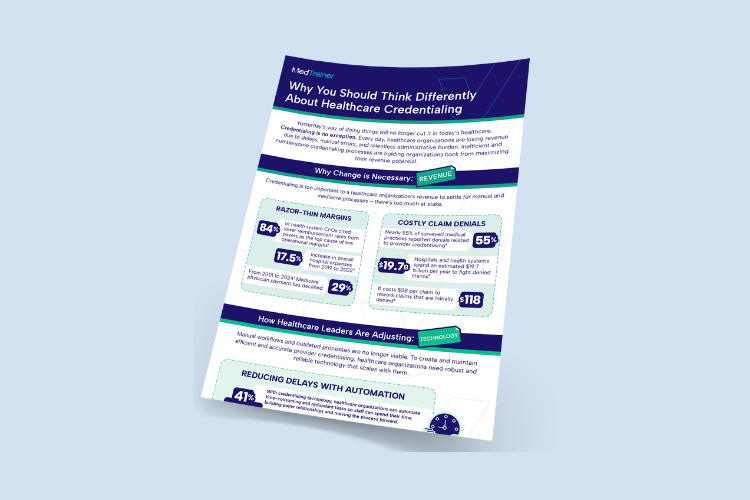
Find out why you need to start thinking differently about credentialing.
Leverage Technology To Improve Credentialing Management in Medical Practices
Healthcare credentialing management software is a digital tool designed to centralize the process of managing and verifying credentials for individuals or organizations. It serves as an all-in-one platform to store, update, and monitor credentials such as licenses, certifications, degrees, and other qualifications.
One of the key advantages of credentialing management software is the availability of information. With an online dashboard, users can access essential data and progress updates instantly. This real-time accessibility allows administrators, providers, and stakeholders to receive immediate answers to inquiries, track the progress of credentialing tasks, and prioritize activities based on expiration dates of provider credentials or certifications. This allows quicker decision-making and improves the overall responsiveness of the credentialing process.
Automated workflows significantly reduce manual intervention. They also prevent bottlenecks and keep the process moving forward so providers can be onboarded quickly and begin seeing patients. Some of the most powerful automations include license retrieval, exclusions monitoring, expiration reminders, and even credentialing packet generation.
Key Functionalities For Medical Practice Credentialing Management
Effective credentialing isn’t just about getting through a checklist. It’s about having the right tools for accuracy, consistency, and visibility at every step. Here are five key features of credential management for medical practices:
Provider Data Management
Centralized provider profiles make it easy to store, update, and retrieve critical information such as certifications, insurance documents, and exclusions. With centralized provider data management, nothing gets lost across email chains or shared drives. This reduces redundancy and keeps every record up to date and accessible.
Highly Customizable Reports
Credentialing teams need to show progress and stay inspection-ready. Real-time reporting tools allow users to generate highly customizable reports that surface the information needed for internal tracking and external compliance needs. Whether you’re checking status, preparing for a survey, or presenting to leadership, you can filter, format, and export data that’s easy to understand and share.
Intuitive Workflows
Intuitive workflows allow you to build repeatable credential management paths. These can be completed with required documents, built-in checklists, and automatic activity tracking. Visual dashboards give you a clear “status at a glance” view. Even if the person managing credentialing gets sidetracked, they can instantly see what’s complete and what’s still pending.
Streamlined Privileging
Managing privileges across multiple facilities can quickly become complicated, especially when providers need privileges at multiple locations, each with its own requirements. Customizable privileging workflows help you track which privileges have been requested, approved, or are under review, all in one place. This transparency makes it easier to manage multi-facility needs without duplicate effort or confusion.
Provider Enrollment Workflows
Delays in enrollment lead to delayed billing and lost revenue. Eliminate these holdups with built-in provider enrollment workflows. With clear task assignments, credentialing applications, and automatic packet generation all in one place, you can track enrollment progress in real time and avoid costly oversights.
MedTrainer Credentialing Software Is Designed For Medical Practices
Thousands of medical practices across the U.S. rely on MedTrainer to improve credential management for medical practices by three weeks on average per provider. That kind of speed matters. It means new hires can see patients and generate revenue sooner, while your team spends less time chasing documents and more time focused on patient care.
MedTrainer’s healthcare credentialing software supports teams and busy administrators. With automated workflows, centralized provider profiles, built-in checklists, and clear task tracking, it replaces outdated manual processes with a centralized system that works for your whole team. Whether you’re credentialing one provider or dozens, you’ll always know what’s been completed, what’s coming next, and who’s responsible.
If your practice is struggling to keep up with recredentialing timelines, it might be time for a change. See how MedTrainer can simplify credentialing for your team — book a demo today.