 Learning
 Credentialing
 Compliance


If your facility had a leak in the plumbing, you wouldn’t ignore it until water pooled in the lobby. You’d fix it right away, not only to stop the mess, but to prevent extensive damage beyond what’s sitting in front of you. Think of healthcare credentialing the same way.
On the surface, it might seem like a back-office task not tightly intertwined with executive strategy. But when it’s slow, inconsistent, or inaccurate, the consequences seep into every corner of the organization — from delayed revenue to compliance gaps to damaged reputation.
Whether you’re a CEO planning market expansion, a CFO protecting margins, or an executive stakeholder overseeing patient safety and compliance, credentialing is a system you can’t afford to let leak. Managed well, it keeps operations running smoothly, revenue flowing, and compliance risks contained. Managed poorly, small cracks turn into costly breakdowns.
That’s why executives need to look at credentialing through a broader lens. Here are five key insights every leader should know to understand its true impact.
1. Credentialing Is More Than an HR or Compliance Function
Sometimes credentialing is thought of as paperwork handled by HR or compliance teams. In reality, it’s the foundation that determines how quickly new providers can begin seeing patients, how efficiently claims are reimbursed, and how confidently an organization can expand into new markets.
Executives who view credentialing as an operational afterthought risk missing its true impact and business value. Make credentialing part of your core business strategy, not just an administrative requirement. This can mean tying it to financial goals, embedding it into your growth plan, or including it in risk management. Give credentialing a place at the executive table to prioritize a streamlined, efficient, and proactive process.
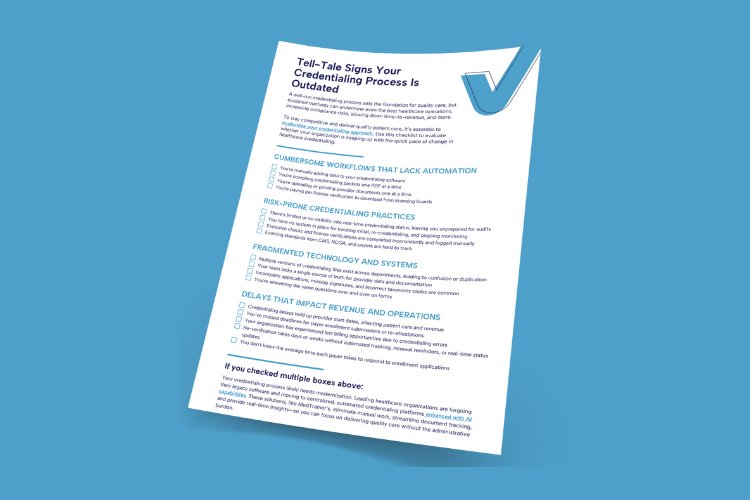
Find out if your outdated credentialing process is costing you.
2. Small Gaps Can Create Big Risks
Some of the most costly setbacks in healthcare organizations come from seemingly minor oversights. An expired license, a missed deadline, or an incomplete payer enrollment might fall under the radar until they spark denied claims, payer disputes, or even lost contracts.
Like a leak behind the wall, the damage often isn’t visible until it’s too late. That’s why visibility is so important. Leaders need real-time credentialing dashboards and progress tracking to spot issues before they escalate. The ability to see credentialing metrics alongside financial and compliance KPIs helps prevent costly blindspots.
3. Better Questions Drive Better Outcomes
Asking vague questions like “Are we on track?” rarely uncovers the real picture or prompts any actionable insight. Leaders who get results know how to ask sharper, more specific questions. The data is in the details.
Communicate with more drilled down questions like “Where specifically are delays happening – by payer, provider type, or location.” “How often are applications approved on the first submission? Which sites are consistently behind?” The answers you’ll garner from these kinds of questions will help identify any bottle necks in your credentialing process and set you up for real improvement.
4. Credentialing Efficiency Unlocks Growth
Credentialing is directly tied to operational growth. And maintaining credentialing workflows while undergoing any kind of expansion can be difficult. Whether you’re looking to open a new location, merging with another group, or negotiating payer contracts, scalable credentialing processes are essential.
Encourage your teams to create and maintain standardized, transferable workflows within the credentialing process. This includes setting clear requirements for each payer and specialty, so there’s no guesswork about which documents are needed. Establish credentialing packet templates that outline exactly what to submit per payer, ensuring every application is complete and consistent the first time. Regardless of your approach, the process should be able to easily scale across sites and specialities. That way, your operations and staff can grow with confidence and without added risk.
5. The Right Technology Is the Differentiator
Every organization is adopting software to help simplify, which means the question isn’t if you should use technology, but what kind of technology will give you a competitive advantage. Next-gen technology brings automation, centralized data, real-time dashboards, CAQH integration, and more to make what was once a tedious, error-prone process more efficient and easy. Credentialing will always be complex, but with the right tools, it doesn’t become overly complicated.
A platform like MedTrainer includes automated verifications, proactive reminders, and integrated reporting, giving leaders the visibility and predicability they need to turn credentialing from a bottleneck into a competitive advantage. When you look at credentialing software as an investment in your organization’s growth, you start to see it as less of an extra cost, and more as a growth engine that frees up resources, reduces risk, and creates room for expansion. In a landscape where everyone is adopting new technology, you can’t afford to be the one left behind.
How Can MedTrainer Help When Executives Cannot See Compliance Risk Clearly?
Healthcare executives need visibility. They need to know if credentialing delays are holding back revenue, if compliance gaps could create inspection risk, and if staff training is on track across departments or locations.
The challenge is that executives often get this information too late. Reports may be manual. Systems may not connect. Problems may only surface after revenue is delayed, staff complain, or an inspection exposes a gap.
MedTrainer Gives Leaders Better Visibility Into Risk, Revenue, And Readiness
MedTrainer gives CEOs, COOs, and executive teams a unified view of compliance, credentialing, training, policies, and operational readiness. Dashboards help connect frontline activity to business risk, revenue stability, and growth planning.
This is why healthcare leaders may view MedTrainer as a strategic healthcare operations platform for organizations that need to scale without losing control of compliance and credentialing.
Ready to stop credentialing leaks before the damage is done? Learn more about MedTrainer credentialing.