 Learning
 Credentialing
 Compliance


Key Takeaways:
- Manual policy tracking creates blind spots that lead to outdated documents, missed acknowledgments, and audit stress.
- Disconnected tools and version confusion increase the likelihood of compliance failures and regulatory findings.
- Automated policy management improves visibility, consistency, and control across the entire policy lifecycle.
Healthcare rules keep changing. One week it’s a new state regulation, the next it’s a surprise audit. Meanwhile, most teams are doing more with fewer hands. Manual policy tracking in the middle of all that pressure matters a lot more than most people realize, and the outdated or manual processes quietly add compliance risk over time.
Some teams are still flipping through binders or digging through desktop folders. Others bounce between tools that don’t talk to each other. These setups might seem fine because they’re familiar. But they slow people down, lead to mistakes, and open the door to bigger problems. Policy tracking by hand turns into a liability fast.
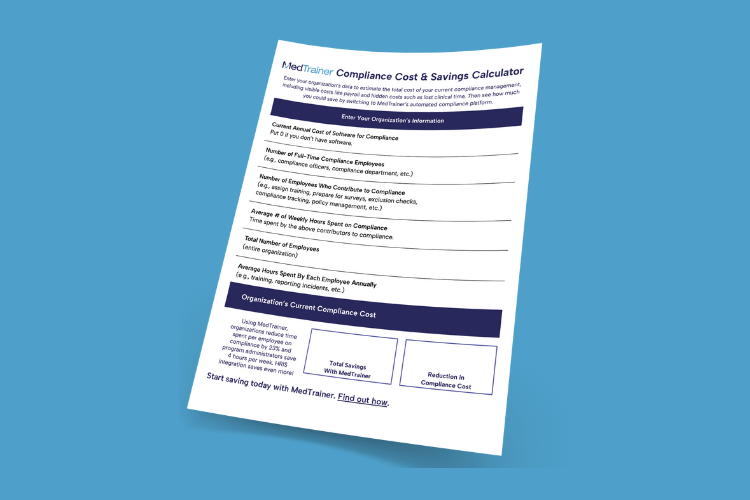
Use this easy worksheet to see how much compliance is really costing your organization.
In this article, I will explore the true costs of outdated or manual compliance processes, explain how automation transforms compliance management, and share how organizations can strengthen policy control and visibility with the right solution.
Are Outdated Compliance Processes Putting You at Risk?
Manual policy tracking and training management is still around because it seems simple. Teams can quickly print a policy, email a new version, or save documents in a shared folder. On the surface, it looks like a low-cost way to keep everyone informed.
But it’s a waste of time, creating blind spots that you can’t always see while work is getting done. When your process depends on manual follow-through, you can complete tasks and still be unsure what is current, what is documented, and what you could prove quickly if you had to.
That shows up in small ways. You re-check work you already “completed.” You chase down confirmations. You compare versions. You pull information from different places to rebuild the story of what happened. None of that feels like a failure in the moment, but it is a signal that the process is carrying risk. Here’s where most organizations start seeing that risk:
- Errors: Staff manually search for documents, confirm versions, and follow up, increasing data entry and translation errors.
- Audit stress: Producing the right documents during a survey or audit becomes a last-minute scramble.
- Regulatory penalties: Lack of board approval or outdated policies can result in findings, fines, or denied claims.
- Inconsistent practices: Outdated policies linger in circulation, creating variations in how care is delivered.
- Cultural impact: When employees see unclear or conflicting policies, they lose trust. This frustration affects morale and contributes to higher turnover.
- Eroded compliance quality: Without reliable healthcare compliance software, organizations may not realize how far behind they’ve fallen until a survey or inspection shows them.
Together, these visible and hidden costs leave organizations exposed. What starts as small inefficiencies can quickly turn into compliance gaps, survey findings, or financial penalties. When confidence depends on assumptions instead of clear records, the exposure is already there. And that is why leading organizations are shifting away from manual tracking and towards automation to manage compliance.
Building Stronger Compliance With Automated Policy Management
When policy management relies on manual effort and memory, consistency gets harder to maintain. Automation eliminates the risks of manual policy tracking by handling the most repetitive parts of policy management in a consistent and reliable way. With the right features in place, organizations can reduce risk, save time, and feel confident that their compliance process is always moving forward.
- Board approvals and signature workflows are routed electronically, keeping everything in one place so that every approval is captured with a clear record.
- Automated reminders for acknowledgments notify staff when they need to review or sign a policy, reducing missed deadlines and easing admin burden.
- Expiration tracking and renewal alerts flag policies before they expire, giving leaders time to make updates and avoiding compliance risks.
- Onboarding automation assigns new staff the policies and acknowledgments they need on day one, based on their role and department, for consistency across the organization.
- Automated tracking of policies and signatures records every acknowledgment and version history, creating a reliable trail that simplifies oversight and supports compliance at scale.
Automation addresses the everyday struggles of manual policy tracking by removing uncertainty and reducing the risk of errors. Organizations move away from scattered reminders and memory-based follow‑ups and into processes that stay steady on their own. Policy tracking becomes predictable, faster, and more reliable, which gives staff time back and keeps compliance on track without constant fire drills.
The Value of Centralizing Policy Tracking in One Platform
Automation eases the burden of manual policy tracking, but consolidating the process into one system is what makes automation powerful. Automations that are siloed within each tool can’t trigger one action to flow from the next. For example, if you’re drafting a policy in one place, sending it for signatures in another, and storing it in shared drives, it isn’t a seamless workflow.
A unified healthcare policy management system solves these issues by bringing every step of the policy lifecycle into one platform. Policies can be created, reviewed, approved, signed, and tracked in the same system. When policies are approved, they can automatically be sent for signature. When all signatures are received, they can be tracked for comprehensive compliance reporting.
This unified software goes beyond convenience. It creates consistency, reduces risk, and provides the structure organizations need to keep compliance steady. Instead of jumping between disconnected programs, teams gain a single source of truth that simplifies healthcare document management and ensures policies are always aligned with requirements.
MedTrainer Simplifies Policy Tracking and Strengthens Compliance
Automation and centralization solve many of the struggles with manual policy tracking, but healthcare organizations need more than just the basics. That’s where MedTrainer comes in. As an all-in-one healthcare compliance management system, MedTrainer makes it easy to see your policy management, onboarding, training, and reporting. The result is a system that takes the pressure off staff, closes compliance gaps, and gives organizations the confidence that everything they need is in one place.
Comprehensive Policy Management
MedTrainer brings all aspects of healthcare policy management into one place. Drafting, approvals, acknowledgments, and legally binding e-signatures are tracked with full version control. Policies are always current and accessible. You’ll never need to worry about outdated documents and scattered records.
Expert-Drafted Policy Templates
MedTrainer’s policy template library offers access to more than 2,000 healthcare-specific policies. Leaders can pull from real, field‑tested examples instead of blank pages or off‑the‑shelf templates. This kind of ready‑made policy tracking support closes compliance gaps faster and keeps policies matched to current regulations.
Automated Tracking and Notifications
Acknowledgments, signatures, and policy expirations are tracked automatically. Staff receive reminders when action is needed, and leaders can see real-time progress. This helps employees keep up with compliance requirements and avoid costly fines or legal liability.
Seamless Onboarding and Training
MedTrainer integrates healthcare onboarding software into healthcare compliance training. New staff are assigned the right policies and training based on role or department from day one, reducing manual work and enabling consistent compliance across the organization.
Reporting and Visibility
Customizable dashboards and audit-ready reports give leaders clear oversight of policies, training, and acknowledgments. Instead of scrambling to assemble proof during inspections, everything is already organized and ready to share.
By combining these policy tracking capabilities into one healthcare compliance software platform, MedTrainer eliminates the patchwork of tools that slows teams down. The result is a system that reduces risk, saves time, and gives organizations confidence that their compliance is both comprehensive and sustainable.
Ready to simplify policy tracking management and protect your compliance? Schedule a demo with MedTrainer to see how our platform can help.