 Learning
 Credentialing
 Compliance


OSHA’s Hazard Communication Final Rule is not one to mess with. It’s already the second most-cited OSHA standard, with 2,888 violations in FY2024. Enforcement of 2024 changes is happening in waves and November 20, 2026 is a key date. Employers must update their safety data sheets (SDS), labels, training, and their written HazCom program as it relates to single substances to maintain compliance.
BUT, there’s a key reason your organization should make those updates immediately. Under OSHA’s general duty clause, knowing about a hazard and failing to act creates liability now, regardless of the November deadline. It’s considered a willful violation and in FY2024, healthcare organizations faced fines up to $165,514.
An OSHA violation is just one of the consequences. Since accreditation requires OSHA compliance, surveyors will likely be asking probing questions and asking for documentation around HazCom moving forward. You definitely want to be prepared for those.
I recently completed a full SDS audit for a MedTrainer client and I shared my learnings in a recent webinar. Based on the audit, I believe most healthcare organizations will need to make updates to their SDS library, training, and HazCom program. In this article, I’ll cover what changed, how to quickly evaluate your SDS library, which products to prioritize, and what a real cleanup looks like.

Complying With the New Hazardous Communication Final Rule
What Did the HazCom Final Rule Change?
OSHA’s Hazard Communication standard has always had five core elements:
- Written HazCom program: Site-specific process for chemical inventory, labels, SDS access, and training.
- Chemical inventory: Accurate list of hazardous chemicals used, stored, or generated in each area.
- Labels and warnings: Shipped labels, workplace labels, and signs match the chemical standards.
- Safety data sheets: Current SDS are readily accessible to employees during each work shift.
- Employee training: Employees understand hazards, protective measures, and how to use labels/SDS.
The Final Rule didn’t change those existing requirements. Instead, it updated the following hazard classifications. Changes to the classifications are what is driving the need to update SDSs, training, and HazCom program materials.
- Skin and eye hazard thresholds
- Gases and aerosols (including a new “chemicals under pressure” category)
- Desensitized explosives, which is a new hazard class that primarily affects pathology and diagnostics labs
How Do You Know if Safety Data Sheets Are Up-To-Date?
The deadline for manufacturers, importers, and distributors to update their safety data sheets passed on May 19, 2026. Some manufacturers have not yet updated SDS for products that meet the new criteria. Don’t assume your supplier has handled it. You should absolutely conduct your own assessment.
I’ve identified four questions that you should ask yourself about every SDS in your library. If you answer yes to either of the first two AND either of the last two, the SDS is not updated and you’ll need to request a new one.
- Was the last revision date before July 19, 2024?
- Has Section 2 been updated for downstream intrinsic hazards?
- Is the product an aerosol or gas?
- Does the product change form when mixed or prepared for use?
As you’re making SDS management updates, it’s important to document every request you make to manufacturers and distributors. If an incident occurs and your SDS is outdated, a documented request shows OSHA you acted in good faith. As per OSHA’s general duty clause, a paper trail always matters. Documentation will also demonstrate good faith in a survey or inspection.
In a recent webinar, I shared a list of products that are commonly used in healthcare facilities and need to be reviewed. Watch the webinar on-demand.
Why Should You Take a Closer Look at Your Organization’s SDS Management?
Here’s something you might not realize — a bloated SDS library is often a bigger problem for your organization than a missing one. Manufacturers provide SDS for everything, including non-hazardous products like band-aids. It’s certainly much easier to just throw every SDS together into a binder or software, but then it’s much harder to find the sheets that actually matter.
OSHA only requires organizations to maintain safety data sheets for hazardous materials. A recent SDS library that I reviewed had 200+ SDSs, approximately 70% were for non-hazardous materials. More than a dozen required safety data sheets for hazardous materials were missing.
Healthcare organizations are required to identify new hazards and communicate to staff before they’re exposed. The best practice accomplishing this is to have an identification process that starts before the item enters the facility.
An SDS cleanup is a risk prioritization exercise. Some key takeaways to apply to your next SDS cleanup:
- Review your product inventory before opening your SDS binder.
- Prioritize missing SDS first, since employees need access during every work shift.
- Document why you excluded non-hazardous products.
- Build a regular review cadence since supplier updates will be staggered.
- Expect SDS changes to ripple into labels, training, PPE, and spill response.
What Is Needed to Maintain OSHA HazCom Standard Compliance?
When an SDS reflects new or updated hazard classifications, it triggers the following chain of required compliance actions.
- Update your written HazCom Program first. It’s your facility’s source of truth. Make sure staff has access to the program and SDS.
- Update workplace labels to match new hazard classifications.
- Review PPE requirements and spill response procedures.
- Retrain employees before they encounter any chemical with updated hazard classifications.
These aren’t just best practices — they’re firm requirements. Neglecting any of those items creates the same liability exposure as an outdated SDS.
One area organizations frequently overlook is household cleaning products brought in outside of purchasing. An inspector once told me that if he finds a bottle of Windex under a sink, that’s a household product. If he finds cases of it, that’s commercial use and it falls under HazCom requirements.
The key is having a process that keeps all of it connected.
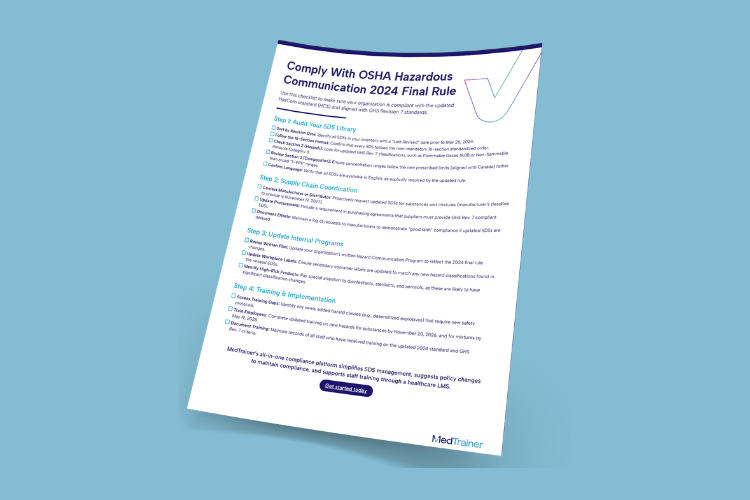
Use this checklist to ensure compliance with the HazCom Final Rule.
How Do You Manage HazCom Compliance Without It Taking Over Your Day?
The challenge with HazCom compliance isn’t just SDS management. It’s simultaneously updating your training, policies, labels, and safety protocols. Most organizations manage those pieces in separate systems. That creates gaps and makes it hard to know where you stand at any given moment.
MedTrainer brings all of it together in one platform. SDS management, compliance training, policy templates, and your written HazCom program all live in the same place. When something changes, you can act on it across every part of your compliance program in one centralized tool.
If you want to see how MedTrainer can help you stay ahead of the November deadline and build a HazCom compliance program that holds up under scrutiny, request a demo today.