 Learning
 Credentialing
 Compliance


At first, it felt like a perfect marriage. The idea of researching a complex compliance topic — like a specific OSHA standard or HIPAA rule — and getting a straight answer without wading through sponsored ads and questionable “news” was revolutionary. My imagination raced. Could this technology provide answers that it has taken me a career to understand?
When I first began experimenting with large language models like ChatGPT, I was genuinely amazed. I threw everything at it: questions about Centers for Medicare & Medicaid Services (CMS) regulations, HRSA requirements, accreditation standards, and more. Most of the time, the answers it returned were surprisingly accurate and comprehensive. However, the key phrase is most of the time.
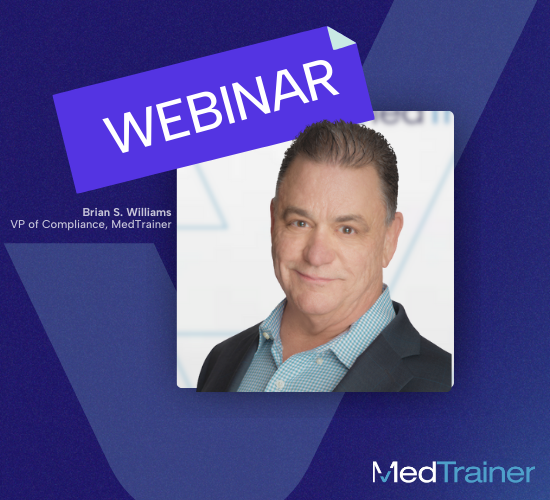
AI in Compliance: Balancing Human Expertise and Technology
Occasionally, an answer would be incomplete or subtly incorrect — an issue I could only spot because of my own experience. This initial excitement quickly evolved into a crucial realization: generic AI is a phenomenal starting point, but it’s not a finished solution for a field as precise as healthcare compliance.
My team’s journey from initial awe to practical application revealed several foundational lessons about how AI can truly work for compliance professionals. The real magic was partnering with MedTrainer’s product engineering department to build out AI tools that could be used by our customers — with confidence — knowing they’re backed by human healthcare compliance expertise. Here’s a look at what we learned along the way.
Lesson 1: The Power of a Defined “Source of Truth”
The “hallucinations” or inaccuracies of generic AI models occur because they are trained on the entirety of the open internet — a vast and often contradictory sea of information. For compliance, this is an unacceptable risk. Our team quickly learned that the single most important factor in achieving reliable AI is to give it a strictly defined “source of truth.”
Instead of allowing the AI to search the entire web, we point it to a curated, closed library of verified documents: the official Code of Federal Regulations (CFR), CMS guidelines, OSHA standards, and specific accreditation manuals. By forcing the AI to draw its conclusions only from these trusted sources, we’re able to transform it from a creative-but-unreliable conversationalist into a meticulous research assistant. It can’t invent answers because its world is limited to the correct ones. This dramatically increases accuracy and builds the trust necessary for professional use.
Lesson 2: The Art of the Structured Prompt
Our second major lesson was learning how to talk to the AI. Simply asking, “What are HIPAA rules?” yields a broad, generic overview. The real power is unlocked through structured prompts that provide context and clear instructions.
A structured prompt is less of a simple question and more of a detailed command. For example, instead of a basic query, we might ask:
“Acting as a compliance officer for a small outpatient surgical center, summarize the key requirements for conducting a HIPAA Security Risk Analysis. Please cite the specific regulatory sections and provide a checklist of five essential items to review.”
This level of detail — defining a role, a context, a specific task, and a desired format — guides the AI to produce a far more relevant, actionable, and precise response. It’s a process that a seasoned compliance team could easily follow, but it takes time and practice. Knowing that AI would be much more user-friendly if structured prompting happened automatically, we built that into the AI Compliance Coach.
Lesson 3: The Need for Intelligent Guardrails
A team of 100+ staff and leaders at MedTrainer collaborated to create and deploy MedTrainer’s vision for AI in healthcare compliance. We brought different expertise and perspectives that proved to be invaluable. I dug into the compliance regulations, technicalities, and details, while the product engineers relentlessly pursued technical deployment. MedTrainer’s leaders were the driving force behind the company-wide initiative to harness the power of AI to lead, not follow our competitors. The truth about AI is that it needs guardrails for intelligent deployment. And collectively, we could do that.
Your healthcare organization’s decision to deploy AI is not just a technical one; it’s a strategic imperative that demands rigorous due diligence. Success hinges on understanding two critical perspectives: that of the organization adopting the AI, and that of the organization that builds it. Considering the source must be intentional.
From Lessons Learned to a Real-World Solution
These discoveries guided our path forward. The company-wide collaboration to build A.I. tools embedded these lessons directly into the design. The AI is highly trained and reliably accurate, but it still depends on the expertise of the compliance professional who is reviewing the results. Our goal was to assist customers with not just answering questions, but with the actual work of compliance. Instead of digging or starting from scratch, the compliance professional has a foundation to analyze and evaluate, which is a huge timesaver.
Here’s what we added to MedTrainer’s platform:
- An AI-powered compliance assistant (Compliance Coach) grounded in a curated source of truth to improve compliance knowledge reliably.
- An AI-powered training assistant (Course Expert) built to compare MedTrainer’s proprietary course library with regulations and accreditation standards to suggest training requirements.
- A vast template library, where AI helps create and customize crucial documentation.
- An AI-powered policy review tool (Policy Guardian) that compares an organization’s policies and procedures against current federal and state regulations, flags non-compliance, and suggests specific updates.
When you combine this intelligent assistance with the platform’s ability to handle the heavy lifting of organizing credentials, training records, and policies in minutes instead of days, it all pulls together. Our journey has taught us that AI isn’t a magic wand. It’s a powerful tool that, when engineered with the right guardrails and focused on solving real-world problems, can finally deliver on its initial promise to the compliance industry.