 Learning
 Credentialing
 Compliance


Picture this: A provider completes credentialing and is ready to work—only to hit a wall. Their privileging is still pending, tied up in a maze of outdated forms, multiple governing boards, and approval layers that vary by site. It’s like playing a game of telephone, where every facility has its own version of the rules. Even when the provider is ready, the process isn’t, and patient care stalls as a result. This is a surprisingly common and costly scenario in healthcare organizations, where privileging often becomes a critical bottleneck in the provider onboarding cycle.
In short, privileging grants providers specific permissions to perform procedures. When this step stalls, the ripple effects are significant. Delayed start dates for providers lead to staffing shortages, lost revenue, and patient care disruptions. Manual follow-ups pile up, administrative teams scramble to track statuses and push privileging through layers of approval committees. Confusion grows and the waiting game begins as organizations juggle complex workflow variations and necessary approvals.
Without a streamlined approach, these issues can quickly escalate, creating frustration for providers and operational headaches for healthcare leaders. Understanding the differences between internal and external privileging processes is a key step in mitigating one of credentialing’s most avoidable pitfalls.
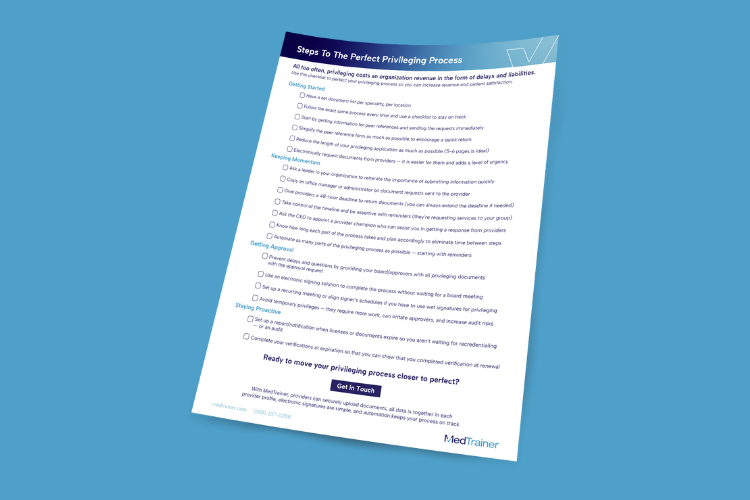
Shorten your privileging process with this free checklist.
Privileging vs. Credentialing
Before we dive in, it’s important to differentiate between privileging and credentialing. Consider credentialing as a baseline step that must be completed before privileging can happen—-credentialing first verifies a provider’s licensing and qualifications, then privileging requires the provider to prove they are capable of the specific skills and procedures they intend to perform.
You can’t begin privileging without completing proper credentialing. Understanding the relationship between privileging and credentialing is key to establishing an efficient privileging workflow at your organization.
Internal vs Hospital (External) Privileging
It’s important to understand the differences between internal and hospital (external) privileging because the workflow changes significantly from one process to the other.
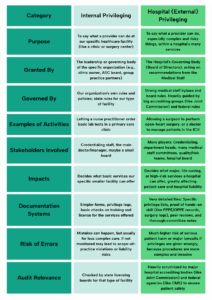
As you can see, each process comes with its own set of players, responsibilities, risks, and impacts, all of which are important for credentialing teams to know and recognize in order to keep their privileging processes running smoothly.
Why the Difference Matters for Credentialing Teams
Credentialing teams are responsible for making sure an organization’s providers are practicing with proper credentialing and within their privileges. If they fail to do so, an organization could be putting patient safety at risk, as well as putting itself at risk of negligent credentialing lawsuits, which can result in significant financial and administrative consequences. Such lawsuits can threaten a hospital’s ability to participate in federally funded programs like Medicare and Medicaid.
If privileging workflows are inconsistent or unclear, credentialing teams are at a significant disadvantage. Navigating the complexities of the different processes adds a layer of complication to the privileging process that makes mistakes and delays far more likely.
Common mistakes such as inaccurate or incomplete application information, lack of visibility into status, incorrect form types, and duplicate work across internal/external silos may result in delays that can come at great cost for any healthcare organization—a provider’s lack of privileges to deliver patient care can cost a healthcare organization thousands of dollars in revenue every day they cannot practice.
Knowing the difference between internal and external privileging workflows ensures the right documents and approvals are obtained for each process — preventing delays, denials, or compliance issues.
How to Reduce Workflow Burden and Delays
There are a number of steps credentialing professionals can take to ensure maximal efficiency and minimal risk in their organization’s privileging process. Leveraging technology to take the guesswork out of provider privileging is the biggest step you can take toward upgrading your organization’s privileging process. A robust software can help your privileging process through:
Standardized forms
Using standardized forms for each type of privileging process lowers the risk of error when completing privileging documentation for either internal or external privileging and streamlines your credentialing team’s work. With dedicated form types for each workflow, your credentialing team can be confident in their process.
Automated requests and reminders
Automated requests and reminders for documentation helps your team avoid any delays due to late documentation submissions, lagging peer recommendations, or expired certifications. Automation cuts back on manual work while also ensuring greater speed and accuracy in completing the provider privileging cycle.
Real-time dashboards
Dashboards let you view the status of each provider going through your organization’s privileging process, helping you stay on top of the tasks that are most urgent like monitoring pending, approved, or expired privileges, and more. Being able to view where each provider is in the privileging lifecycle also gives you essential visibility into the health of your privileging process, allowing you to spot where things often snag.
Centralize documentation
Using software to centralize your documentation makes it easy for your credentialing team to stay organized throughout all stages of either the internal or external privileging process. By storing documents for either workflow in one central location, credentialing staff can work efficiently without the frustration of searching for lost documents.
How MedTrainer Helps Simplify Privileging Workflows
MedTrainer simplifies the privileging process by offering a centralized, automated platform that significantly reduces administrative hurdles and accelerates provider onboarding. Our solution reduces administrative burden, streamlines privileging, and ensures compliance at every step. Some MedTrainer features include:
Customized Privileging Forms: Whether you’re onboarding a podiatrist or an anesthesiologist, privileging requirements differ based on procedures, technology access, and training levels. MedTrainer allows credentialing professionals to build custom delineation of privileges forms tailored to specific specialties and organizational needs, ensuring providers are approved for the appropriate privileges and appointments without managing multiple applications.
Centralized Privileging Management and Workflows: MedTrainer provides a single hub to manage all your privileging documents and tasks, organize them into workflows that can track and update the status of your privileging processes, and even generate customized credentialing packets tailored to different privileging scenarios.
Read more about all MedTrainer can do to support your privileging process here.
With an understanding of the different privileging workflows and how software can help navigate them with ease, administrators can create a credentialing strategy that works smarter, not harder, for their organization. Give credentialing teams the tools they need to work efficiently and confidently. Get started with MedTrainer today.