 Learning
 Credentialing
 Compliance


Healthcare provider data management is harder than ever. More data is required and there are more hoops to jump through. But, it’s critically important because inaccurate data or poor management causes credentialing delays, denied claims, compliance penalties, and even medical mistakes when unlicensed or sanctioned providers are allowed to practice.
In most cases, poor provider data management is not intentional negligence — it’s a sign of a busy healthcare organization using outdated processes. This is especially common in settings where staff shortages are prevalent and patient demand is high, such as Indian Health Services (IHS) or tribal health. These settings may not have adequate hiring oversight or the time for continuous monitoring that is now standard in the industry, but their reliance on CMS (Centers for Medicare and Medicaid) and other government funding means greater oversight.
When provider data is incomplete, outdated, or fragmented, compliance failures become far more likely, and far more costly. In this article, I’ll share how healthcare organizations are overcoming bad provider data management practices and the value that technology can bring.
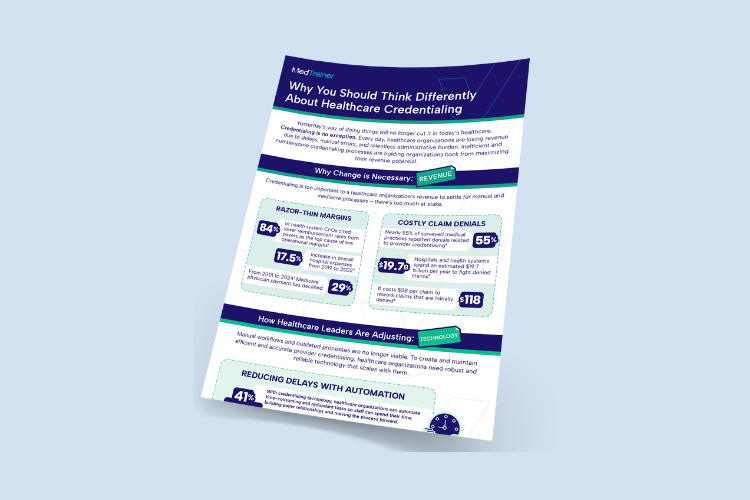
Find out why you need to start thinking differently about credentialing.
The Risks of Poor Provider Data Management
Failure to maintain accurate provider data puts healthcare organizations at risk for revenue loss and audit deficiencies. Here’s a look at potential risks to your organization:
Revenue Loss
Inaccuracies in a provider’s information, such as an incorrect payer contract effective date, can cause denied claims, delayed reimbursements, and the need for write-offs. Since providers see many patients in a day, a data problem doesn’t just impact one claim – it impacts claims for all services the provider has rendered, which can lead to substantial revenue loss.
Regulatory Non-Compliance
Organizations are required to keep a record of a provider’s ability to practice. Missing primary source verifications or inconsistent credentialing files across facilities can result in face fines, penalties, and potential legal action. For facilities who accept government funding, such as Indian Health Services, there are more frequent checks of this information through HRSA (Human Resources and Security Administration) operational site visits (OSV) and CMS inspections, increasing the risk of non-compliance being detected.
Employing Unqualified or Excluded Providers
Employing or having an excluded provider on staff is dangerous. If not frequently checked, providers could be practicing with expired, revoked, or restricted licenses. Sanctions from state boards or federal agencies can go undetected if exclusion list monitoring is not completed periodically (NCQA requires every 30 days). Unqualified providers not only lack the necessary skills to deliver quality care but can also expose your organization to hefty fines, loss of funding, and more if discovered.
How Bad Provider Data Management Affects Compliance
Bad provider data management has a direct, compounding impact on compliance, which is amplified in organizations experiencing workforce instability, legacy systems, and heightened federal oversight. When provider information is incomplete, outdated, or spread across disconnected systems, organizations may have no idea if unlicensed or improperly credentialed providers are practicing. What starts out as just a missing license, document, or privileges quickly turns into regulatory exposure, audit findings, and patient safety issues. Let’s say the person who checks provider license expirations gets sidetracked and doesn’t send out a reminder or pause patient scheduling after the expiration date. Before you know it, an unlicensed provider is seeing patients and could be until the oversight is discovered in the next OSV or CMS survey – where you could face findings.
Compliance isn’t just about doing the right thing – it’s about being able to demonstrate it. Bad provider data management could mean files are sloppy, not accessible, or inaccurate. In any of those circumstances, it’s hard to demonstrate compliance if you can’t find the information or the information you’re accessing is wrong. It’s why keeping all provider data in a centralized, online platform with automatic tracking just makes sense. When actions are completed, like checking exclusions, it’s automatically tracked so you can prove when it was completed and by whom.
Inaccurate provider data management also directly impacts billing and coding, leading to compliance violations and financial losses. When provider credentials, NPI numbers, or payer enrollments are incorrect or outdated, claims submitted to insurers may be flagged as improper billing. This increases the risk of claim denials, delayed reimbursements, and potential fraud investigations.
Revenue Loss from Data Errors
Revenue loss from poor provider data management primarily results from credentialing issues, billing errors, and enrollment delays. Credentialing-related problems are one of the leading causes of denied insurance claims, as payers require accurate, up-to-date provider information to process reimbursements. This is especially important for government payers, such as Medicare and Medicaid. PECOS 2.0, the online platform for the Centers for Medicare and Medicaid (CMS), is designed to enforce cleaner, more reliable data across Medicare, Medicaid, and commercial plans.
When credentialing data is incomplete or incorrect, claims are rejected, resulting in delayed payments and increased administrative work to correct and resubmit claims. Additionally, billing errors caused by inaccurate provider records lead to inefficiencies and higher administrative costs. Enrollment delays further disrupt revenue cycles, as unprocessed provider applications prevent billing and payment processing.
Without proper enrollment, providers cannot generate revenue, leading to cash flow interruptions. To minimize financial losses, healthcare organizations must ensure accurate credentialing, automate data management, and streamline provider enrollment processes. This can be easier by using an all-in-one healthcare credentialing software, like MedTrainer.
Improving Provider Data Management Accuracy
Many healthcare organizations are turning to technology to improve provider data accuracy. The adoption of software that drives new processes and automation can improve compliance and reduce lost revenue.
Centralize Provider Data
Software that offers customizable and comprehensive provider profiles keep all provider data in one location that is accessible based on system permissions. Having all provider documents saved in the same place makes it easy to verify information and know when tasks are complete. The best healthcare credentialing systems offer completion percentages so you can see at-a-glance how much information is missing.
Reduce Manual Data Entry
Manual data entry is one of the most common sources of bad provider data. Software that integrates with other internal systems, such as HRIS, can eliminate redundant data entry. Even more important is a direct CAQH integration that pulls from the industry’s most trusted provider data source directly into the credentialing software.
Automated Notifications
Software automates reminders for expired licenses, new exclusions, and document requests. Providers receive periodic email reminders until all required documents are uploaded, creating a sense of urgency. This improves staff efficiency and ensures provider data remains up to date.
Surface Missing Data
Ideally, you should have a way to see expiration dates for important certifications, licenses, and documents. Software with robust credentialing reporting makes this information far more accessible than spreadsheet tracking, and can even be emailed on a recurring basis (at the beginning of each month) to avoid expirations. Some software, for example MedTrainer, offers color-coded dashboards that highlight missing information, saving you and your organization time that would be spent rummaging through paper files or disparate systems.
Harness AI
As artificial intelligence (AI) grows in popularity and capabilities, look for applications that will improve your provider data management. For example, relying on AI to complete forms or enter information based on a verified document will reduce the chance of data entry errors or inaccuracies.
Benefits of Proactive Provider Data Management
Making a change to your provider data management process will take you from reactive (panicking after a claim denial) to proactive (getting an updated license before expiration). The benefits are outsized for organizations like Indian Health Services and Tribal health centers because of the limited administrative resources and increased federal oversight.
Here are some benefits of having a proactive approach when it comes to provider data management:
Faster Provider Onboarding
With software, providers have much better visibility into the healthcare onboarding process. Electronic document requests can be sent to providers upon signed contracts, so you can start collecting documents sooner. If a provider is missing any credentialing documents, for example, they will have consistent alerts to remind them about it, speeding up the process and getting them ready to go.
Reduced Claim Denials
Credentialing-related denials can come in many ways, but when you have reports that identify the most common issues–such as when a provider is out of network or a license is expiring–it can prevent revenue loss before it happens.
Improved Operational Efficiency
The top priority of healthcare organizations should be to deliver quality care, not to spend hours chasing missing documents or building complex PDFs to send for enrollment or privileges. When all your provider data is in one safe location, your whole organization will be less stressed and can focus on what really matters.
Improve Provider Data Management With Credentialing Software
Bad provider data management creates compliance risks and financial losses, which are often far greater than the cost of a solution, such as credentialing software. By updating your processes and implementing technology, you can take a proactive approach that will reap benefits in the long run.
A credentialing platform like MedTrainer includes electronic document requests, comprehensive provider profiles, robust reporting, and more to simplify provider data management. See how MedTrainer could benefit your organization.