 Learning
 Credentialing
 Compliance


Healthcare onboarding best practices are the sensible way to stay ahead of what seems like a revolving door in today’s staffing environment, especially for rural hospitals and Indian Health Services (IHS), who face long-standing, severe staffing shortages.
According to the 2022 NSI National Healthcare Retention & RN Staffing Report, the average facility turnover rate among employees in 2021 was 25.9%. That means HR teams ended up replacing an average of one in four workers!
An improved healthcare new hire onboarding process won’t be able to solve the geographic, financial, or cultural challenges that some organizations face, but it can give you a better shot of keeping current staff. By turning it from a long and tedious process with dozens of boxes to check into a great introduction to the organization, you can avoid costly delays and improve job satisfaction. Plus, when a good onboarding process includes medical credentialing, then you’re also getting providers paid faster, which will make them happier in your facility.
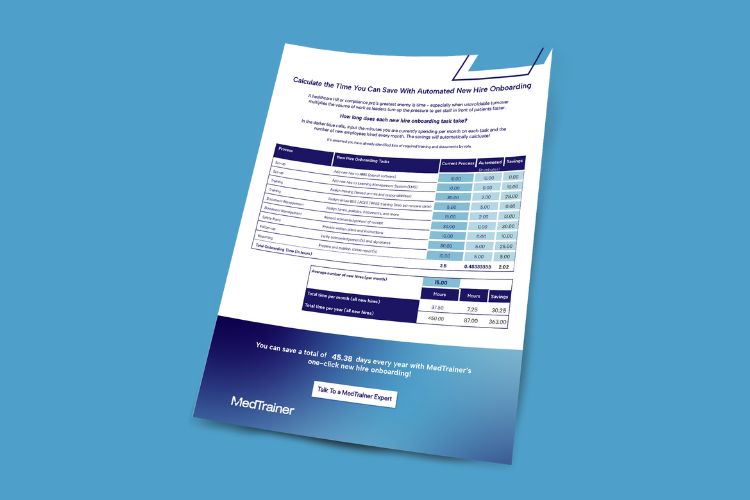
Calculate the time you can save with automated new hire onboarding.
How Improved Healthcare Onboarding Reduces Staff Turnover
Statistics show that employees who have exceptional onboarding experiences are more likely to say they’re extremely satisfied with their workplace, and more likely to stay. This can help to counteract any negatives associated with your organization’s location, available salary, and workload. That’s great news for rural hospitals and IHS facilities who may struggle to attract and retain staff.
Organizational Connection
First impressions matter. Giving new hires a great healthcare onboarding experience is how you get an above-and-beyond commitment from them. Show them what makes your organization special — engaged employees who feel a meaningful connection to the organization and a commitment to improvement will be less tempted to leave. Don’t forget NPPs and locum tenens providers – they may be more likely to extend contracts or return with a positive onboarding experience.
Increased Confidence
A chaotic onboarding experience signals organizational dysfunction or lack of support. Keep things consistent and clear. Anytime you can reduce time in training, clinicians will be grateful. Use role-specific courses and AI to identify exactly what’s required so staff get exactly what they need to perform their job.
Faster Time To “Feeling Useful”
Sitting around or feeling like the organization isn’t prepared for their start can make clinicians feel frustrated or disengaged before they even begin. Using healthcare onboarding best practices, organizations can help new hires feel productive sooner, increasing job satisfaction and getting hires in front of patients sooner. Healthcare onboarding software is especially helpful in getting employees ramped and contributing more quickly.
Six Healthcare Onboarding Best Practices
Making just a few tweaks to your new hire onboarding in healthcare, you can reap the benefits. Here are a few ideas to improve your process:
1. Share the larger purpose of your organization.
According to research by Brandon Hall Group, 88% of organizations say it is critical that “employees believe in what the organization stands for” as part of the onboarding process. To bring this to life, healthcare onboarding best practices call for training materials that share your organization’s mission, vision, and values. It could be a pre-recorded video from the CEO, a story about how the organization helps patients, or a group chat with a leader to explain what makes the organization special. This can help to reduce staff turnover in your organization.
2. Talk about the value of an employee’s specific role.
Sometimes it’s hard for new staff to see how a lower-level role is impacting the organization’s mission. Making this connection during onboarding will help you build an immediate relationship with the new hire and improve retention. Consider sharing quotes or short videos that profile staff members who put their own personality or spin on their work, and who can share how their role contributes to the overall mission.
3. Develop a connection with coworkers.
Increase new hire engagement by scheduling time during meetings for ice-breakers or games that help employees get to know each other better. Encourage onboarding leaders to take individual staff members to lunch or coffee. This healthcare onboarding best practice shows employees they are valued, gives leaders an opportunity to hear from staff, and helps to decrease staff turnover.
4. Begin onboarding as soon as the offer is accepted.
Healthcare is one of the most highly regulated industries, so you need to start the onboarding process immediately to prevent paying the new hire to sit in the breakroom their first week. Healthcare-specific training is required for every employee, and if you use an online learning management system, you can give them access before their first day.
Some healthcare organizations even offer virtual new hire orientation. The employees can complete their training and policy acknowledgments from home before even coming to the facility. All of these ideas help to prevent the costly delays that add up with new hires aren’t able to start contributing immediately.
5. Make it easy for new hires to get up to speed.
An online system makes the healthcare onboarding process that much quicker and smoother for new employees. With a system that allows electronic form-filling for HR documents, reviewing policies, completing training remotely, and easy visibility into progress, new hires can be ready to begin practicing in a fraction of the time when compared to a manual process.
6. Check in on progress.
Checking in during healthcare onboarding helps you to smooth out the process. You may find that many people are getting stuck at the same point, or performance is poor in a certain course, and you need to make updates. While you can reach out to the new hire and ask for feedback at any point, it is much easier to check progress and performance using a compliance management platform.
Use Technology to Improve New Hire Healthcare Onboarding
Onboarding new employees in a medical facility is no small feat. On average, it can take up to eight weeks to ensure that all the necessary credentialing and training are in place for a healthcare new hire — a process that can be extended when you add the ideas above. But the time is well worth it. In addition to the healthcare onboarding best practices, implementing onboarding software with automation can make a big difference.
Automate Healthcare Onboarding
Use healthcare onboarding software to automatically assign all necessary training, HR forms, and policy reviews based on the new hire’s role, location, and department. The HR team can assign all needed courses in a couple of clicks, instead of multiple processes, and the new employee knows exactly what needs to be completed.
Automatic Reminders and Reporting
Manually sending reminder emails is probably one of the most time-consuming parts of onboarding. An onboarding compliance software will automatically send reminders based on the course or attestation due date. Plus, you can schedule reports to automatically send to your inbox to stay on top of completion.
Digitize Credentialing
The credentialing process is tedious for everyone. Use a digital credentialing system that enables you to email providers a link to a secure online platform where they can upload their documents. Now, it’s even easier with the help of an AI Upload Assistant.
Continuous reminders and a standardized workflow will ensure no credentialing tasks fall through the cracks. Lastly, using a digital credentialing system that has a secure API integration with CAQH helps your team get clinicians credentialed faster. With one click, you can pull data directly from CAQH’s database into your credentialing software, saving time and reducing errors.
Accessible Anywhere
Don’t let paper forms and files hold back your new hire. Start healthcare onboarding automation online so new hires can fill out paperwork and complete training online instead of waiting until their first day of work. It’s easier for you as well — no more filing!
Ready to take your healthcare onboarding to the next level? Schedule a demo with MedTrainer to see how we can help.