 Learning
 Credentialing
 Compliance


Healthcare organizations know credentialing is essential, but many underestimate just how much it impacts financial performance. Credentialing delays, errors, and compliance gaps slow down onboarding, draining costs every day. That’s why smart organizations are turning to AI-powered healthcare credentialing ROI strategies.
By utilizing AI-powered healthcare credentialing, leaders can accelerate onboarding, minimize errors, and keep compliance airtight. The result? Transform credentialing from an administrative headache to company growth.
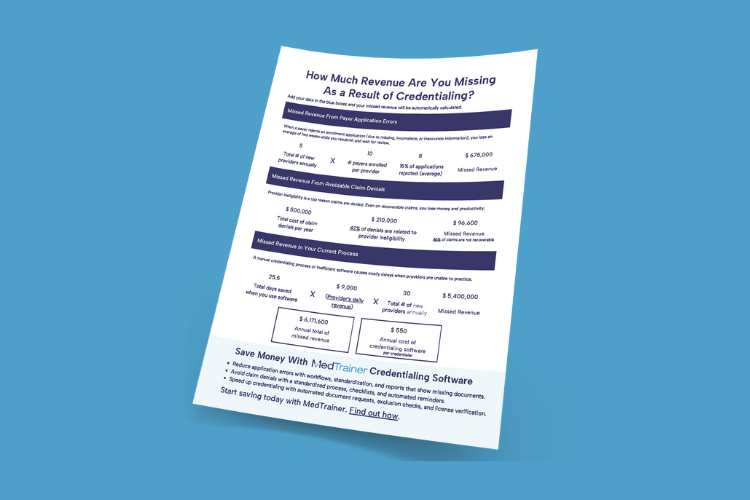
Find out how much revenue your provider credentialing process is losing.
Credentialing’s Impact on Revenue
Credentialing touches every corner of a healthcare organization. And as I’ve shared before, credentialing is the foundation that determines how quickly new providers can begin seeing patients, how efficiently claims are reimbursed, and how confidently an organization can expand into new markets. When done well, it accelerates time to revenue and boosts patient access. When done insufficiently, it causes costly ripple effects.
Credentialing Delays
Every day a provider waits on enrollment is a day of lost revenue — in some cases, as much as $10,000 per provider per day.
Those delays don’t just create short-term setbacks. They compound quickly into significant financial losses. Faster onboarding means providers can see patients sooner. This increases patient volume and stabilizes revenue streams. Beyond immediate financial impact, an AI-powered healthcare credentialing process makes an organization more attractive to top-tier providers and acts as a long-term driver of patient retention and reputation.
Claim Denials and Write Offs
Inaccurate provider data is one of the leading causes of claim denials. According to CMS, credentialing errors and outdated enrollment data can directly result in denied claims, delayed reimbursements, and higher administrative overhead. Consistent provider data management will help prevent denials and write-offs. And fewer denials mean steadier cash flow, less time spent on appeals, and reduced accounts receivable burdens.
Patient Experience
Credentialing delays affect patients, too! Providers who are quickly enrolled across multiple payers can expand patient coverage, shorten wait times, and create a more accessible patient journey.
Patients who experience problems in coverage due to enrollment errors are more likely to lose trust in the organization. Hearing a provider can’t see you yet because they’re not properly credentialed? It isn’t exactly a reassuring start. Beyond that, enrollment errors can spark costly issues and compliance penalties.
Efficient credentialing gives confidence that providers are where patients need them, when they need them. That trust turns into long-term loyalty, stronger retention, and ultimately, stronger ROI.
3 Ways AI-Powered Healthcare Credentialing Boosts ROI
Gone are the days of thinking quality AI support is a futuristic possibility. It’s here and it’s already transforming credentialing in ways that directly drive financial returns.
1. Faster Time to Revenue
AI accelerates credentialing cycles by automating repetitive, manual tasks. Think automated primary source verification, communication follow-ups, payer enrollment status updates, form completion, and more. This means less time spent chasing documents and more time with providers actively seeing patients and generating revenue.
With AI credentialing software, teams can handle seasonal surges like summer graduate influxes without losing weeks of billable patient care.
2. Increased Accuracy
Credentialing can only move as fast as the accuracy of provider documentation allows. Even minor errors create ripple effects that result in re-credentialing, claim denials, or regulatory flags. As much as we may not want to admit it, AI is much less likely to make errors than humans are. So it’s time to embrace what it can do for you!
AI in medical credentialing reduces these risks by cross-referencing provider data across systems, flagging inconsistencies instantly, and standardizing entries. The result is fewer administrative oversights, stronger payer confidence, and reduced claim denials and write-offs.
3. Compliance and Risk Mitigation
Credentialing is as much about compliance as it is about cash flow. Errors, oversights, or delays can lead to costly penalties, reputational damage, and even malpractice claims.
An AI-enabled credentialing platform improves the accuracy of credentialing records without the need for human intervention. This means reduced risk of regulatory fines and credentialing-related malpractice claims, as well as lowering insurance costs and protecting the organization’s reputation.
What To Look for in AI-Powered Healthcare Credentialing Software
To maximize ROI, organizations should look for healthcare credentialing software that combines automation with healthcare-specific expertise designed to create efficiencies. Without compromising quality or compliance. Features to look for might include:
AI-Powered Task Elimination: Credentialing comes with endless form entry, verifications, and document tracking. Look for AI-powered healthcare credentialing software to do this automatically — from pulling provider data off uploaded forms to pre-filling fields in payer applications. This frees healthcare credentialing specialists to focus on provider relationships and compliance oversight instead of paperwork.
Built-In Accuracy Safeguards: Platforms like MedTrainer use AI to flag mismatched license types, catch missing information, and enforce data consistency across records. Fewer errors mean fewer delays, fewer denials, and greater confidence in compliance.
Faster Provider Onboarding: Automated provider onboarding with AI speeds up the process with features like bulk document uploads, automated requests for missing information, and AI classification for credentialing documents.
Proactive Risk Management: Credentialing software should prevent problems, not just respond to them. AI-enabled systems can identify risks before they escalate by flagging upcoming license expirations, conducting ongoing monitoring, spotting incomplete enrollment packets, and generating renewal reminders early enough to avoid compliance gaps.
The bottom line: AI on its own isn’t enough. To truly see ROI, organizations need healthcare credentialing software that combines intelligent automation with healthcare-specific expertise. Platforms like MedTrainer bring those elements together to help deliver faster onboarding, fewer errors, and stronger compliance, all while giving executives the visibility and confidence they need to scale.
Integration With Automation
With automation, AI works best. Together, healthcare credentialing automation and AI support can eliminate manual steps, ensure consistency, and keep compliance checks audit-ready.
Here are key non-AI technologies that you shouldn’t overlook:
Credentialing packet automation: Compiling credentialing packets by hand is one of the most repetitive tasks credentialing teams face. AI for payer enrollment automation now makes it possible to gather all necessary documents and combine them into a single, standardized packet (complete with a cover sheet) in seconds.
Automated license verification: It’s tedious to click through state licensing board websites, facing potential fees and reCAPTCHA. Credentialing software that has APIs with state licensing boards to automatically pull data and an image can save an abundance of time through this on-demand access. Look for solutions that’re able to immediately validate all license types across all 50 states.
CAQH integration: Integrations don’t always rely on AI, but they’re critical for eliminating redundant data entry and improving accuracy. Seamless CAQH profile management ensures payer information is always up to date, while HRIS connections reduce duplicate administrative work and create a single source of truth across systems.
Pairing automation with AI gives credentialing teams a setup that moves faster and works cleaner. Repetitive tasks disappear. Every record stays the same, no matter who touches it. Audits go smoothly. MedTrainer builds AI into tools that already work well so healthcare teams get more done and stop wasting hours fixing the same issues. The result is less stress, better accuracy, and a clear path to stronger returns.
Red Flags When Looking at AI-Powered Healthcare Credentialing
When considering AI-powered healthcare credentialing ROI strategies, it’s important to keep in mind the risks and downsides of automated intelligence – particularly in healthcare. Choosing the wrong system or leaning into iffy shortcuts can create more problems than it solves.
Leaders should be cautious of platforms that push AI as a total replacement for credentialing staff. This risks introducing compliance gaps and errors. AI credentialing software should reduce repetitive work, not replace human oversight. Look for technology that supports your team, not substitutes for it. That being said, generic AI tools not built for healthcare may miss regulatory nuances, payer requirements, or state-specific rules.
An AI-enabled credentialing platform should be trained on healthcare’s unique demands. If an AI tool can’t explain how it reached a decision, it’s risky. In credentialing, defensible, documented workflows are essential for compliance and audits. Avoid solutions that lack transparency or clear reporting.
Expert Built, AI Supported
AI in credentialing is only valuable if it’s built with healthcare’s realities in mind. MedTrainer takes this a step further, blending expert-built credentialing workflows with AI and automation that directly solve the problems credentialing teams face every day (including our own).
From the AI Upload Assistant that eliminates hours of manual document review, to AI Form Mapping that auto-populates payer applications, to real-time dashboards, automated license verification, CAQH profile management, and exclusion monitoring, MedTrainer gives organizations the tools they need to see ROI fast.
With MedTrainer, credentialing can become a strategic advantage rather than just another compliance box to check off. Faster provider onboarding, fewer claim denials, stronger compliance, and clearer visibility into operations all add up to meaningful financial results. That’s the power of AI-powered healthcare credentialing software when it’s delivered by MedTrainer.
Ready to see how MedTrainer can help you scale credentialing with confidence? Schedule a demo today.