 Learning
 Credentialing
 Compliance


Healthcare compliance programs help facilities stay on track with rules and regulations. They keep patients safe, protect private data, and hold everyone accountable.
At its core, a healthcare compliance program is a systematic approach designed to meet medical compliance guidelines. It keeps healthcare organizations and their staff in line with the many and constantly changing federal and state regulations, industry standards, and internal policies governing their operations. Beyond simply following the rules, a compliance program in healthcare also reflects an institution’s commitment to quality care, patient rights, and operational integrity. Finally, a healthcare compliance program includes assistance to prevent the costs associated with non-compliance, which can include penalties and lost reimbursement. All of this can factor into your organization’s reputation.
Ready to evaluate compliance software options? Start here.
Why Is a Healthcare Compliance Program Important?
To answer the overarching question, “What is a compliance program in healthcare?” let’s first discuss the importance of compliance. Healthcare is an in-depth field, marked by countless regulations and ethical standards. The best healthcare compliance program assists entities in navigating these regulations correctly, staying within legal and ethical bounds. The primary goal is ultimately risk mitigation by meeting health regulations and standards.
In order to reduce risk to patients and staff, healthcare compliance programs identify and address vulnerabilities. Patients, trusting providers with their health and personal data, need assurance of safety, privacy, and quality care. These are some of the risks you take without a modern healthcare compliance program:
- Legal Violations: Healthcare facilities may unknowingly violate federal and state laws, such as the False Claims Act, Anti-Kickback Statute, and Stark Law, which can lead to legal action, fines, and penalties.
- Loss of Reimbursement: Non-compliance with regulations can result in the loss of Medicare and Medicaid reimbursement, which can significantly impact your revenue.
- Civil and Criminal Penalties: Violations of healthcare laws and regulations can result in civil and criminal penalties for individuals and organizations involved. This may include fines, imprisonment, or exclusion from government healthcare programs.
- Reputation Damage: Bad experiences lead to bad reviews. Healthcare facilities that fall victim to fraud or lack safety measures may suffer reputational damage, which can affect patient trust and confidence.
- Financial Loss: The cost of legal defense, fines, and potential settlements can have a severe financial impact on healthcare organizations.
- Operational Disruption: Non-compliance issues can disrupt daily operations, divert resources, and lead to inefficient processes.
- Increased Audit Scrutiny: Facilities without healthcare compliance programs are more likely to be subject to audits and investigations by government agencies and payers.
- Patient Safety Concerns: Non-compliance can compromise patient safety and quality of care, leading to negative events and potential lawsuits.
- Difficulty in Attracting Talent: Healthcare professionals may be reluctant to work at facilities with a history of compliance issues, making it challenging to find and hire qualified staff.
- Difficulty in Partnering: Healthcare facilities may face challenges in forming partnerships with other healthcare organizations, insurers, or vendors if their compliance practices are questionable.
What Are the Key Components of an Effective Healthcare Compliance Program?
Every compliance program in healthcare will have unique nuances, but some elements are universally vital. The OIG sets a standard with seven fundamental elements of an effective compliance program:
1. Implementing written policies, procedures, and standards of conduct.
Well-documented policies and procedures serve as the backbone of a reliable healthcare compliance program. They provide clarity, so everyone understands their roles and responsibilities. When a facility has sufficient, well-considered policies and practical guidelines in place, doctors, nurses, and staff know how to handle any given situation. Failing to follow these policies and procedures can put patients and the facility at risk.
2. Designating a compliance officer and compliance committee.
A dedicated compliance officer or committee has a wide range of responsibilities, from developing and implementing compliance programs to monitoring everyday compliance operations to adapting corrective action plans. Better patient care, improved workplace safety, lower organizational costs, better accountability. All of these and more stem from the work a healthcare compliance officer does to create compliance across the board.
3. Conducting effective healthcare training and education.
Consistent compliance training in healthcare is crucial as it keeps staff informed and engaged. A high-quality training program emphasizes the importance of compliance and reinforces its principles. By having employees undergo this necessary training, you help establish a proactive compliance effort and set a valuable foundation for good standing within the healthcare industry.
4. Developing effective lines of communication.
Open channels with clear communication for reporting concerns and incidents are essential. This openness contributes to improving both patient care and workplace safety by shedding light on accidents and near misses, training gaps, and areas where practices may require adjustments. Well-written, comprehensive incident reports are critical, and an online incident reporting system can help this process.
5. Enforcing standards through public disciplinary guidelines.
Make sure all employees know your organization’s compliance expectations and that they are consistently enforced, in the same way with the same consequences. It’s making sure everyone takes it seriously. Taking steps to widely publicize your compliance expectations and procedures supports a culture of continuous healthcare compliance and accountability.
6. Responding promptly to detected offenses and undertaking corrective action.
An effective program adapts to new challenges, regulatory changes, and institutional growth. Data collected through incident reports is a goldmine of information that can drive improvements in patient safety and operational efficiency.
Online incident reporting systems allow for systematic data analysis and enable healthcare organizations to identify trends, patterns, and areas that require targeted interventions. Being responsive means long-term sustainability for a proper healthcare compliance program.
7. Conducting internal monitoring and auditing.
Regular evaluations of the healthcare compliance program help identify gaps that could be putting your organization’s compliance status, or worse, patient safety, at risk. Internal audits are crucial for maintaining a program’s effectiveness and integrity. By proactively making improvements, your organization will be better prepared for external regulatory inspections.
How Can Technology Help You Meet Healthcare Regulations and Standards?
When choosing a leading provider of some of the best healthcare compliance solutions, like MedTrainer, here’s what you’ll want to look for.
Flag Regulatory Changes
AI-assisted healthcare compliance software, such as MedTrainer, automatically flags out-of-date policies and suggests edits, eliminating hours of research and rewrites. AI-enhanced workflows can also identify required compliance training by state, role, and care setting, with the option to assign the courses directly from the search results.
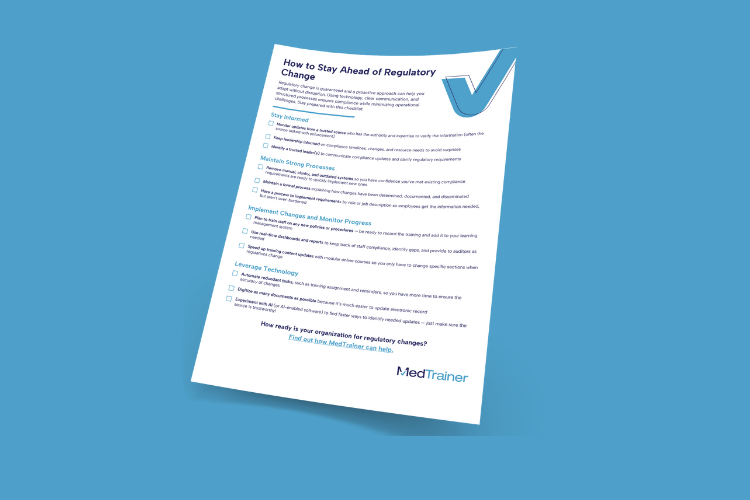
Stay ahead of regulatory change and minimize disruptions with these tips.
Real-Time Reporting
Provides immediate insights into compliance metrics, allowing for swift fixes when problems arise. Home to one of the best healthcare compliance reporting software available, MedTrainer offers customizable dashboards where users can easily filter, sort, and present information in a way that supports both big-picture oversight and detailed analysis is the gold standard. This flexibility gives leaders immediate access to clear, actionable insights, allowing them to make informed decisions to quickly address potential compliance gaps.
Automated Course Reminders and Notifications
Sends reminders to employees from the time a course is assigned until it is completed. This keeps staff “in the know” and the organization compliant with mandated training requirements. Healthcare compliance program administrators can also receive reminders to assign annual or new-hire training.
Document and Policy Management
Streamlines the creation, modification, and distribution of critical compliance materials. Choosing a full-cycle healthcare policy management software puts all parts of the process in one platform to eliminate wasted time, extra software, and outdated processes. Collaboration, version tracking, electronic signatures, storage, and reporting right within one platform means there’s no more back and forth with documents across teams.
Also, policy management software that offers automations such as reminders, tracking, and storage streamlines the complex process and helps offload the administrative burden for compliance teams.
Online Incident Reporting
Allows staff to easily and anonymously flag potential issues for timely escalations and resolutions. An online incident reporting system simplifies the reporting process for employees, which helps to build a culture of compliance and proactivity. Plus, online incident reporting in an all-in-one software offers incident report trends that can help you identify incident trends before they become a serious problem.
Make the Most of Your Compliance Program in Healthcare
Now that you know what a successful healthcare compliance program is and looks like, it’s easy to see why it’s an integral part of any healthcare facility. Hopefully, it is also clear why leading healthcare organizations turn to software to simplify this complex, and sometimes tedious, process. The software keeps your organization within the law, protects patient safety, and supports high standards of care.
While setting up and maintaining an efficient program requires effort, the benefits – in terms of risk mitigation, enhanced trust, and operational excellence – are well worth the investment. MedTrainer is preferred by professionals looking for some of the best compliance programs in healthcare.